
Home / News / Bing Tests 'Read More' Links In Search
Bing Tests 'Read More' Links In Search
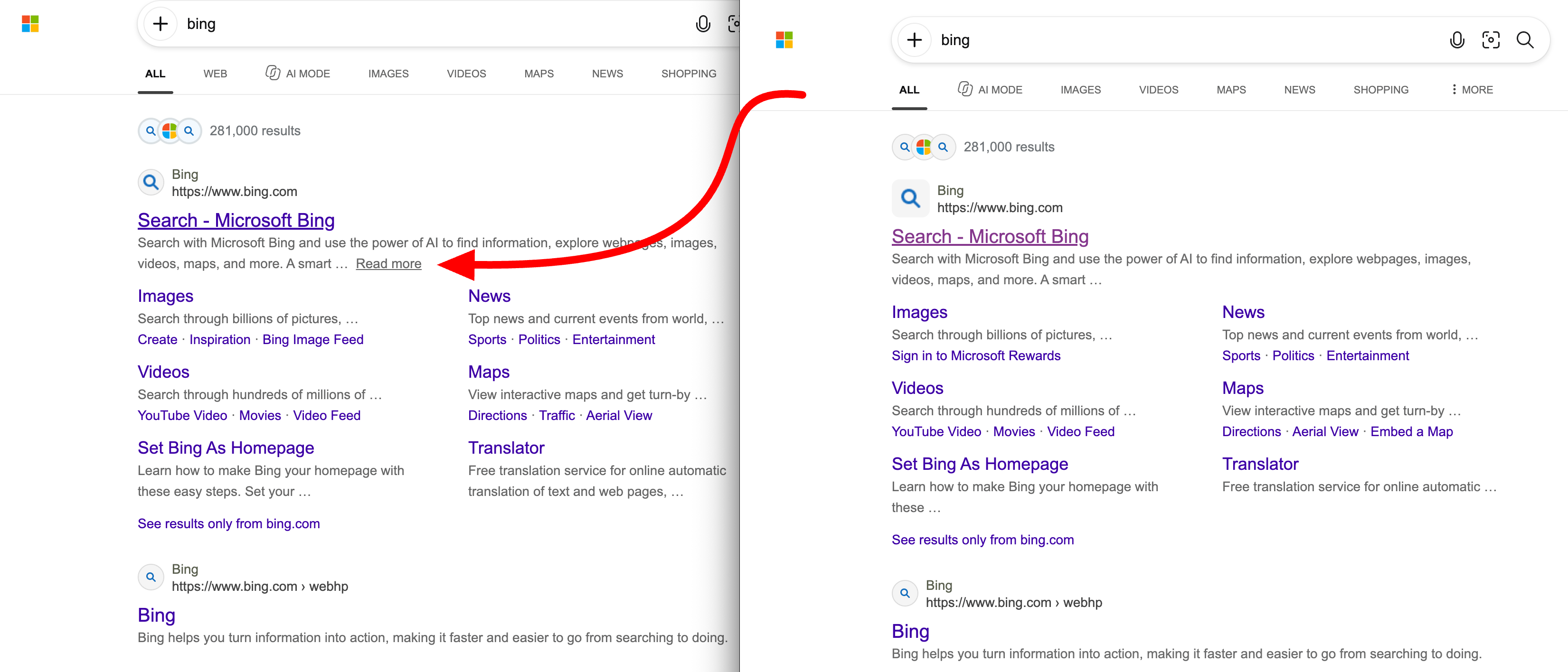
Microsoft is piloting a “Read More” link that appears at the end of Bing search result snippets, echoing a feature Google rolled out last year. The link leads to the same destination as the headline, giving users an additional way to reach the page without clicking the title.
Key Highlights
- ✓Bing Testing 'Read More' Links in Snippets
- ✓Mirrors Google's Recent UI Update
- ✓Links Directly to the Same Destination as the Title
- ✓Signals Shift Toward AI-Driven Search Interfaces
What Happened: Bing's New UI Test
For years, search engine results pages (SERPs) have followed a simple pattern: a blue, clickable title, a URL, and a brief description. Microsoft is now testing a new twist on that formula. According to Search Engine Roundtable, Bing is experimenting with “Read More” links embedded directly in the snippet text.
Unlike Google’s recent approach, which expands the snippet itself, Bing’s version adds a discrete anchor at the bottom of the description. Clicking that anchor takes users to the exact same URL as the headline, effectively offering a second pathway to the page without requiring a title click.
Key Details of the "Read More" Link
Understanding how this test works can help business owners stay ahead in Generative Engine Optimization (GEO).
- Placement: The link appears at the end of the description, typically between the snippet text and the displayed URL.
- Functionality: Rather than scrolling within the page, the link redirects to the same destination as the main headline, confirming the snippet’s relevance or providing a shortcut to the full content.
- Replication: Early observations show the feature on certain browsers and in specific regions, but it has not yet rolled out to the entire Bing ecosystem.
- Context: The move arrives as search engines double down on AI‑generated content and aim to deliver more value directly on the SERP, reducing the number of clicks needed to satisfy a query.
What It Means for Business Owners
For marketers, this UI tweak is more than a visual change; it signals a broader shift in how search engines prioritize information.
The Shift to Zero‑Click Search
Zero‑click search is gaining traction—users increasingly expect answers right on the results page. By inserting a “Read More” link, Bing acknowledges that a plain snippet may not always fulfill a query, yet it still wants to keep users engaged with the result list. The trade‑off could be fewer direct visits to your site, but a higher chance of being featured in AI‑driven overviews.
Implications for AI Overviews and Citing
VisibilityAI and similar platforms scrape snippet text to generate answers in tools like ChatGPT, Perplexity, and Google AI Overviews. If Bing continues to highlight a “Read More” link, the snippet’s wording becomes even more critical. A concise, context‑rich snippet improves the odds that AI systems will cite your page, even if the user never clicks through.
Optimizing Your Content Strategy
To adapt, consider these tactics:
- Snippet Optimization: Craft meta descriptions and the opening 150‑160 characters of your content to be clear, compelling, and packed with the most relevant information.
- Structured Content: Use headings, bullet points, and schema markup so both search engines and AI tools can parse your page quickly.
- Robust FAQ Pages: Frequently asked‑question sections often trigger “Read More” links, making them a strategic asset for capturing those interactions.
Actionable Takeaways for Marketers
- Monitor the SERP: Regularly check Bing results for the “Read More” link and note which competitors appear alongside you.
- Deliver on the Promise: Since the link points to the same URL as the title, the landing page must fulfill the expectations set by the snippet.
- Prep for AI Crawlers: Clear, high‑quality snippet text boosts the likelihood that AI tools will reference your content as a reliable source.
In short, while still a test, Bing’s “Read More” experiment foreshadows a more text‑centric, AI‑informed search experience. Businesses that fine‑tune their snippets and front‑load valuable information will be best positioned to thrive.
Why This Matters For Your Business
The introduction of a “Read More” link on Bing signals a concrete step toward zero‑click search, where the search engine itself aims to satisfy the user’s intent before they leave the results page. For business owners, that shift means the snippet—often the only piece of their content a user sees—carries more weight than ever in shaping brand perception and driving indirect traffic. AI‑powered tools such as ChatGPT, Perplexity, and Google AI Overviews pull directly from snippet text to generate answers. When Bing highlights a “Read More” link, it underscores the importance of concise, high‑value copy in the first 150‑160 characters. Optimizing that space not only improves click‑through rates but also increases the chances that AI systems will cite your page, amplifying visibility even without a direct visit. Ultimately, the test reflects a broader industry trend: search engines are blending traditional SERP design with AI‑driven content delivery. Companies that treat their snippets as mini‑landing pages—clear, authoritative, and answer‑focused—will maintain relevance in a landscape where the line between search and AI assistance continues to blur.
Frequently Asked Questions
Does this mean I should stop optimizing my meta descriptions?
No. In fact, the test makes meta descriptions even more critical. The “Read More” link reinforces the idea that the snippet itself is a key ranking signal, so a compelling, accurate meta description can still drive engagement and credibility.
Will this affect my website's traffic?
Potentially. If users satisfy their query via the snippet or an AI overview, click‑through rates may dip. However, enhanced snippet visibility can also raise brand awareness and lead to indirect traffic from AI‑generated answers.
Is this available globally yet?
At present, the feature appears to be limited to certain browsers and regions as part of a controlled rollout. It is not yet a permanent, worldwide change on Bing.
Is your business showing up in AI search?
Get your free AI visibility audit - see if ChatGPT, Perplexity, and Google AI actually recommend you.