
Home / News / Google Ads Expands Business Name Rules, Giving Advertisers More Flexibility
Google Ads Expands Business Name Rules, Giving Advertisers More Flexibility
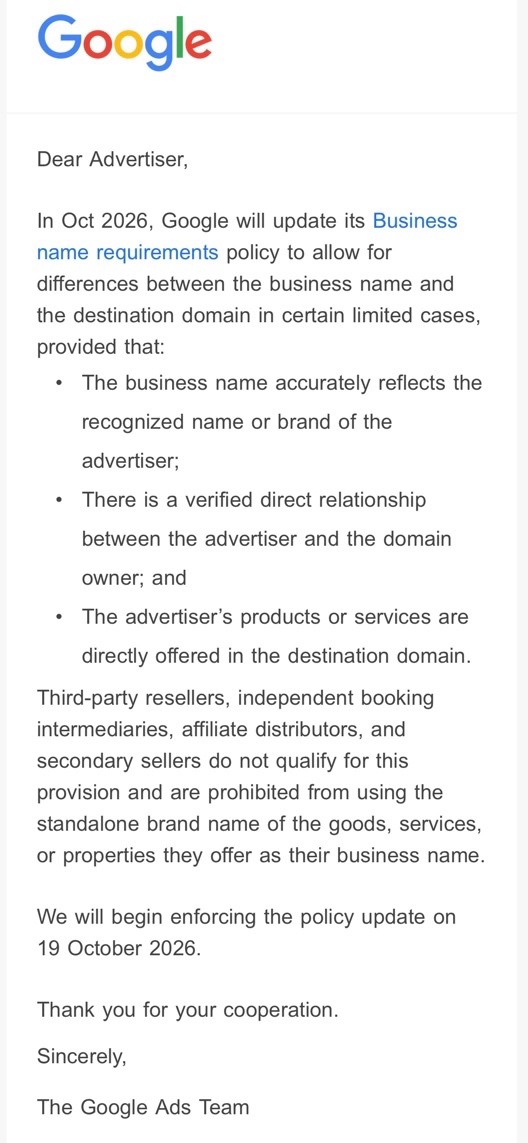
Google Ads is loosening its business‑name rule, letting verified brand owners display a brand name that differs from the landing‑page URL in three narrowly defined situations. The change excludes unverified third‑party sellers and will roll out in a phased rollout starting early November.
Key Highlights
- ✓Google Ads now permits a brand name that differs from the landing‑page domain in three specific cases.
- ✓Eligibility requires verified brand ownership; unverified third‑party sellers are excluded.
- ✓The change helps align ad copy with real‑world brand names, improving AI citation accuracy.
- ✓Rollout begins in November with a phased pilot before full implementation.
What Happened
Google Ads announced a policy update that permits advertisers to include a business name in their ads even when that name doesn’t match the destination URL. The flexibility is limited to three well‑defined scenarios and is available only to advertisers who can prove they are the verified brand owner. Search Engine Roundtable first reported the change, and Google expects to begin the rollout in the next few weeks.
Key Details
- Three approved cases – The new rule applies when:
1. The advertiser’s legal business name differs from the domain they own (e.g., a franchise operating under a parent brand).
2. The business uses a well‑known trade name that isn’t reflected in the URL (e.g., "Joe’s Coffee" landing on joe‑cafe.com).
3. The advertiser runs a regional or multi‑location campaign where the domain is generic (e.g., "bestplumbers.com" for a local plumber named "Ace Plumbing").
- Verification is mandatory – Only advertisers who have completed Google’s brand verification process can take advantage of the new flexibility. Unverified third‑party sellers or resellers must still match the ad name to the destination domain.
- No impact on existing disapproval rules – The update does not relax policies around trademark infringement, deceptive practices, or misleading URLs. Ads will continue to be reviewed against Google’s broader ad‑policy framework.
- Implementation timeline – Google plans a phased rollout beginning in early November, starting with a pilot group of eligible advertisers before expanding to a wider audience. Existing campaigns won’t change automatically; advertisers must edit their ad copy to use the new naming option.
What It Means For Your Business
1. Align Your Brand Voice Across Channels
Small businesses often have a brand name that differs from their website URL—think of a local bakery called "Sweet Crumbs" that uses the domain sweet‑crumbs‑bakery.com. Previously, Google would flag such ads for a mismatch, forcing owners to either alter their headline or purchase a matching domain. With the new policy, you can keep the recognizable brand name in the headline while directing traffic to the existing URL, preserving brand consistency across Google Search, Google Maps, and AI‑driven overviews.
2. Boost AI‑Generated Citations
AI tools like ChatGPT, Perplexity, Gemini, and Google AI Overviews pull data from structured business listings, ad copy, and organic search results to generate citations. When your ad headline mirrors the exact business name that appears in local listings and review sites, AI models are more likely to recognize and cite your brand accurately. This can improve visibility in AI‑generated answer boxes, voice assistants, and conversational search experiences.
3. Protect Your Brand From Competitors
By using the verified brand name in ads—even if the URL differs—you reduce the risk of brand‑squatting or competitors hijacking a similar domain to capture traffic. The verification step ensures only the legitimate owner can claim the name, adding an extra layer of protection in the crowded digital ad space.
4. Simplify Campaign Management
Marketers no longer need to maintain multiple domain variations just to satisfy Google’s naming rules. This reduces technical overhead, allowing you to focus on ad creative, audience targeting, and conversion optimization. For local businesses with limited marketing resources, that simplification can translate into more budget for ad spend and better ROI.
5. Stay Compliant, Stay Visible
The policy change does not relax Google’s broader ad‑policy standards. You must still avoid deceptive practices, ensure the landing page provides a good user experience, and respect trademark rules. However, the added flexibility means you can comply more easily while still presenting a clear, trustworthy brand message—an essential factor for AI systems that prioritize reputable sources.
Action Steps for Business Owners
- Verify your brand in Google Ads Manager if you haven’t already. The process involves uploading trademark documentation or a business registration.
- Audit your current campaigns to identify ads where the headline business name differs from the domain.
- Update ad copy to reflect the verified brand name where eligible, keeping the destination URL unchanged.
- Monitor performance after the rollout. Look for changes in click‑through rates (CTR), conversion rates, and any AI‑driven citation improvements in tools like Google Business Profile.
- Stay informed on Google’s policy updates by subscribing to Search Engine Roundtable or the official Google Ads blog.
---
By taking advantage of Google’s new business‑name flexibility, local and small businesses can strengthen brand alignment, enhance AI‑generated discoverability, and streamline ad operations—all while staying within Google’s trusted advertising ecosystem.
Why This Matters For Your Business
For businesses that rely on AI tools to surface their information, consistency between the brand name shown in ads and the name that appears in local listings, review sites, and structured data is crucial. AI models favor sources that present a clear, repeatable identity; a mismatch can cause the same business to be treated as multiple entities, diluting citation strength. By allowing a verified brand name to appear even when the URL differs, Google helps ensure that AI‑driven search experiences—whether a conversational answer from ChatGPT or a quick fact from Google AI Overviews—recognize and credit the correct business. Many small enterprises operate under a **trade name** that resonates more with customers than the technical domain they own. Previously, they faced a trade‑off: either change the ad headline to match the URL (risking brand confusion) or risk ad disapproval. The new policy removes that friction, letting marketers focus on **creative messaging** and **conversion optimization** rather than technical compliance. This shift can boost click‑through rates, improve ad relevance scores, and ultimately enhance organic visibility as AI systems surface the most authoritative, consistently‑named sources.
Frequently Asked Questions
Can I use a completely unrelated brand name in my Google Ads?
No. The new policy only applies to the three specific scenarios and requires you to be the verified brand owner. Unrelated or third‑party names remain disallowed.
Do I need to change my website URL to match the new ad name?
No. The update allows the ad headline to differ from the landing‑page domain, so you can keep your existing URL while using the verified business name in the ad.
How does this change affect my ad approval process?
If you meet the eligibility criteria and have completed brand verification, your ads should pass the naming check. All other policy checks (trademark, deceptive content, landing‑page quality) still apply.
Is your business showing up in AI search?
Get your free AI visibility audit - see if ChatGPT, Perplexity, and Google AI actually recommend you.