
Home / News / Google AI Mode Lets You Curate Preferred Sources for Citations
Google AI Mode Lets You Curate Preferred Sources for Citations
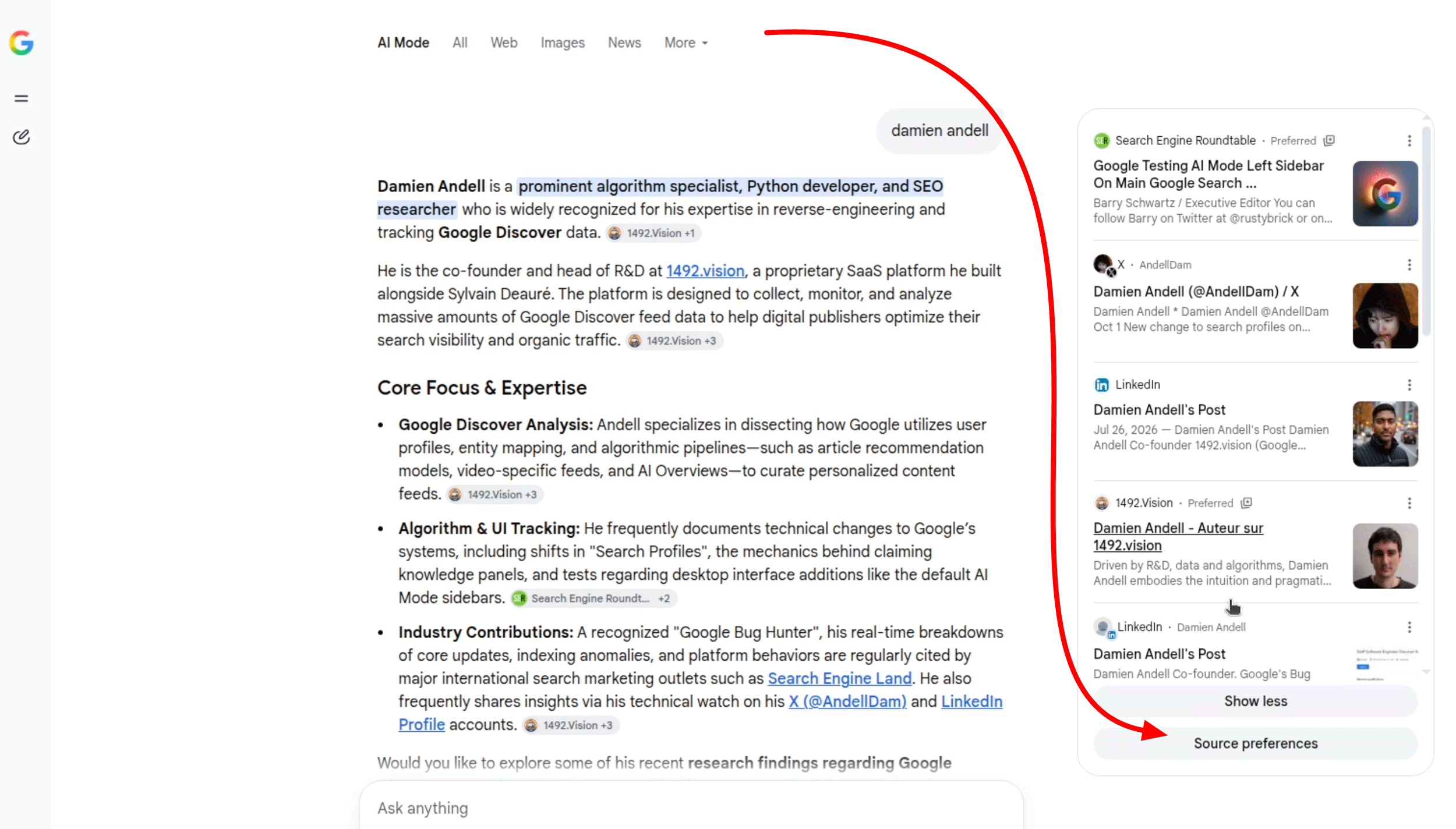
Google is piloting a new “Source preferences” button in the AI Mode citations sidebar, letting users add, remove, or reorder the sites they trust. This gives businesses a direct way to influence which of their pages appear in AI‑generated answers, opening a new traffic channel for local and small brands.
Key Highlights
- ✓Users can now edit a preferred‑source list directly from the AI sidebar.
- ✓Preferred sources are prioritized in AI citations, increasing visibility.
- ✓The feature is in a limited rollout, currently desktop‑only.
- ✓Businesses can proactively add their own pages to boost citation chances.
What Happened
Google is quietly testing a Source preferences button inside the AI Mode citations sidebar. Clicking the button opens a modal that lists the user’s “preferred sources,” which the AI will prioritize when it creates citations. From this panel, users can add a URL, remove an existing entry, or reorder the list to signal which sites they trust most. The feature is part of Google’s broader push to make AI‑generated answers more transparent and to give users a say in the data that powers those answers.
The rollout builds on earlier experiments that displayed citation links at the bottom of AI responses but left source selection entirely to Google’s ranking algorithms. By handing control to the user, Google hopes to curb misinformation, improve relevance, and introduce a new “source‑ranking” signal that businesses can influence.
Key Details
- Location: The button appears in the right‑hand sidebar of Google’s AI Mode (formerly Gemini Chat) on desktop Chrome. Mobile versions are slated for a later rollout.
- Functionality: Users can type or paste a URL, select from recent searches, or import a CSV of domains. A brief preview of the page’s title and meta description helps users confirm they’ve chosen the right source.
- Visibility: Preferred sources are highlighted in the citation list with a star icon. When the AI has several credible options, it surfaces the starred source first.
- Testing Phase: The feature is in a limited A/B test, visible to roughly 5‑10 % of AI Mode users. Google is gathering feedback on usability, relevance, and potential abuse.
- Impact on Ranking: While the exact algorithmic weight remains undisclosed, Google engineers have confirmed that a site appearing on a user’s preferred list can receive a boost in citation likelihood for that user’s future queries.
- Privacy Considerations: Preferred‑source lists are stored locally in the browser and are not shared across accounts, ensuring personal curation does not become a data‑collection vector.
What It Means For Your Business
1. **Higher Probability of Being Cited**
If a local business or marketer adds your site to their preferred‑source list, Google’s AI is far more likely to cite you in future answers. That citation appears as a clickable link, driving high‑intent traffic directly from an AI chat window.
2. **Control Over the Narrative**
You can proactively add your own “knowledge hub” pages—such as a detailed FAQ, product spec sheet, or brand story—to the list. This ensures the AI pulls the most accurate, brand‑approved information rather than an outdated third‑party article.
3. **Competitive Edge in AI Search**
Many small businesses still focus solely on traditional SERP rankings. By optimizing for AI citations, you can capture a new audience segment that interacts with Google via chat rather than classic search results.
4. **Synergy With Existing SEO Practices**
Traditional SEO signals—backlinks, E‑E‑A‑T (Experience, Expertise, Authoritativeness, Trustworthiness), structured data—remain critical. The preferred‑source UI simply adds another layer where those signals can be displayed to the AI.
5. **Actionable Steps for Small Businesses**
- Audit Your Core Pages: Ensure title tags, meta descriptions, and schema markup accurately reflect the content you want the AI to cite.
- Create a “Citation‑Ready” Hub: A concise page that answers the top 5‑10 questions customers ask about your product or service. Use clear headings and bullet points.
- Leverage Google Business Profile: Keep your address, hours, and phone number up‑to‑date; AI often pulls this data when it needs quick factual answers.
- Monitor the Sidebar: When you see your site in the preferred list, note which pages are highlighted. Replicate that structure on other high‑value pages.
- Use VisibilityAI Tools: Our platform scans AI citation data from ChatGPT, Perplexity, Gemini, and Google AI Overviews, showing you which of your pages are already being cited and where gaps exist.
- Reach Out to Influential Users: If you have partners or loyal customers who regularly use AI Mode, encourage them to add your site to their preferred list.
6. **Long‑Term Outlook**
Google’s experiment hints at a future where source selection becomes a ranking factor similar to backlinks. Marketers who treat AI citation as a first‑class SEO asset will likely enjoy a sustained traffic advantage as chat‑based search grows.
---
In short, the new Source preferences button turns AI citations from a black‑box output into a tunable signal. By aligning your content strategy with this emerging feature, you can turn Google’s AI chat into a reliable referral engine for your local or small business.
Why This Matters For Your Business
For businesses that depend on local search, AI‑driven answers are rapidly becoming a major traffic source. When a user’s AI Mode cites a website, the link appears in a conversational context that often carries higher trust than a traditional organic result. Getting onto a user’s preferred‑source list lets a small business tap into that trust and capture clicks from users who are already in a buying mindset. The preferred‑source list also introduces a **new ranking signal** that sits alongside backlinks and keyword relevance. Marketers can influence AI behavior without needing to understand the underlying machine‑learning model. In practice, well‑optimized local pages—clear FAQs, up‑to‑date Google Business Profile data, and structured schema—can be deliberately surfaced in AI answers, delivering qualified leads that might otherwise never see the brand.
Frequently Asked Questions
How can I add my website to the preferred‑source list?
Open the Source preferences panel, click “Add URL,” paste the address of the page you want cited, and confirm. The page then appears in the list and is highlighted with a star for future AI responses.
Will being on a user’s preferred list improve my rankings for everyone?
The boost is **user‑specific**. If many users add your site, the aggregate effect can resemble a traditional ranking signal, but each citation remains tied to the individual’s preferences.
Is there any risk of spam or abuse with this feature?
Google stores the list locally in the browser and caps the number of entries per user. Abuse reports are monitored, and suspicious patterns may trigger automatic removal of low‑quality sources.
Is your business showing up in AI search?
Get your free AI visibility audit - see if ChatGPT, Perplexity, and Google AI actually recommend you.