
Home / News / Google AI Overviews Now Cover Team Rosters—Small Biz Impact
Google AI Overviews Now Cover Team Rosters—Small Biz Impact
Google’s new AI Overviews now display complete sports team rosters directly in the SERP, often pushing traditional site links down. Small businesses can stay visible by making their data AI‑ready with structured markup and real‑time updates.
Key Highlights
- ✓Google’s AI Overviews now surface full sports team rosters directly in search results.
- ✓The feature can replace traditional site links, especially for exact roster queries.
- ✓Small businesses must use structured data and concise content to be cited.
- ✓Accurate, real‑time updates are essential to maintain visibility in AI Overviews.
# Google AI Overviews Invade Team Rosters
Oct 1, 2026 - 7:41 am — by Barry Schwartz
What Happened
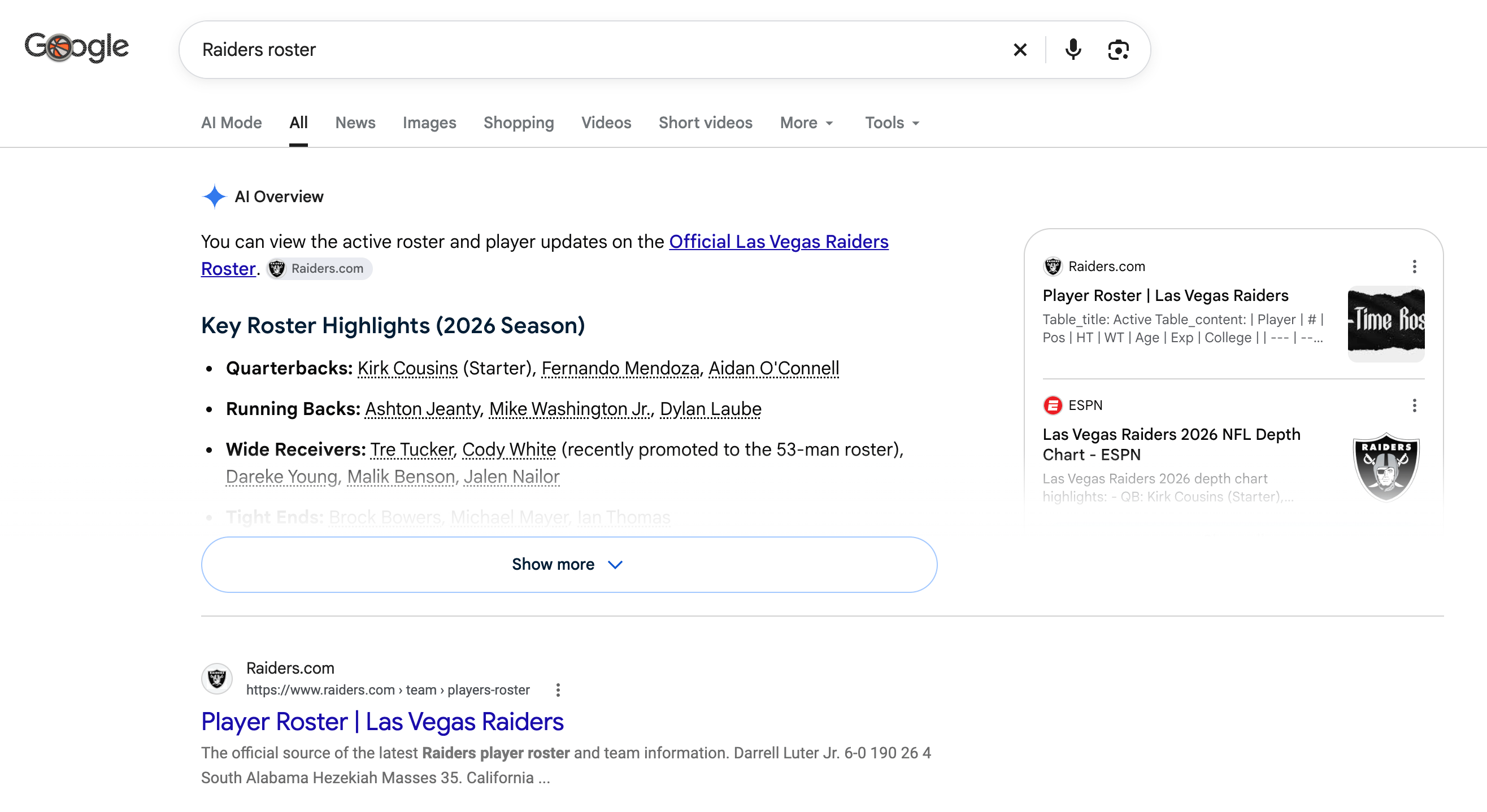
Google rolled out an AI‑driven feature that automatically generates "AI Overviews" for sports team rosters. When a user types a query such as "Raiders roster," the engine pulls the latest lineup from trusted sources and presents a concise, AI‑written summary right in the SERP. This box can appear instead of, or alongside, the usual list of website links, especially when the query matches the exact roster format.
Industry watcher Glenn Gabe first flagged the change on X, noting that a live‑game search for the Raiders roster produced a compact AI Overview on desktop and a longer, scroll‑heavy list on mobile.
Key Details
- Scope of the feature: At launch it covers only sports rosters, but Google has hinted at extending the format to other structured data types such as event schedules, product specifications, and local‑business hours.
- Data sources: The AI draws from Google’s own index, partner sites, and publicly available APIs. Natural‑language processing reshapes the raw data into a conversational snippet.
- Impact on SERPs: For roster‑related queries, the AI Overview claims the top spot, often pushing traditional website results lower or removing them altogether.
- Visibility for small businesses: Companies that keep up‑to‑date roster or event information may see their data cited directly by the AI, which can raise brand awareness while simultaneously siphoning clicks away from their pages.
- Control and updates: Google reflects only the information it has indexed, so content owners must keep their structured data accurate and refreshed in real time.
What It Means For Your Business
1. Embrace Structured Data
Implement Schema.org markup for any roster‑style content. Proper markup signals to Google that your data is authoritative and ready for AI extraction.
2. Optimize for AI Answers
Google favors brief, fact‑based responses. Draft copy that answers the most common questions about your business in clear, bullet‑point form, and include essential details such as hours, services, and contact information.
3. Monitor Traffic Shifts
A drop in impressions for roster or event queries often means the AI Overview has taken the prime position. Use Search Console to watch changes in impressions and CTR, then adjust your SEO focus to other keyword groups or enrich your pages to encourage clicks.
4. Leverage AI Citations
When Google’s AI cites your brand, it can boost credibility. Ensure your business name, address, and phone number (NAP) are consistent across all listings and on Google Business Profile.
5. Future‑Proof Your Strategy
Google plans to roll AI Overviews out to additional data types. Keep all structured data current and create content that answers “what,” “who,” “where,” and “when” questions to stay ahead of the next presentation format.
Key Highlights
- AI Overviews now surface full sports team rosters directly in search results.
- The feature can replace traditional site links for exact roster queries.
- Small businesses must adopt structured data and concise copy to be cited.
- Real‑time accuracy is crucial for maintaining visibility in AI Overviews.
Why It Matters
The emergence of AI Overviews marks a shift from a link‑centric model to an answer‑centric one. Instead of directing users to a website, Google now delivers a ready‑made, AI‑generated response that satisfies the query at a glance. For local and small businesses, simply having a website is no longer enough; the content must be structured, up‑to‑date, and succinct enough for the AI to reference.
Being cited in an AI Overview can enhance brand trust, but it also reduces the likelihood of a click through to your site. Understanding this trade‑off lets you fine‑tune your SEO strategy—targeting keywords that still drive traffic or crafting richer pages that invite deeper exploration beyond the AI snippet.
As Google expands the feature to event schedules, product specs, and local‑business hours, the search landscape will become increasingly conversational and data‑driven. Early adopters who implement schema markup, monitor AI citations, and optimize for quick answers will enjoy a competitive edge as the SERP evolves.
FAQs
- Q: Will my website still rank for roster queries?
A: Yes, but the AI Overview will likely occupy the top slot. Correct structured data increases the chance your site is cited.
- Q: How can I get my business cited in AI Overviews?
A: Use appropriate Schema.org markup, keep your information current, and write clear, concise answers that the AI can extract.
- Q: Does this affect local SEO?
A: It does. Verify that your Google Business Profile details are accurate and consistent across all online listings to maintain authority in AI‑driven searches.
Why This Matters For Your Business
The emergence of AI Overviews marks a shift from a link‑centric model to an answer‑centric one. Instead of directing users to a website, Google now delivers a ready‑made, AI‑generated response that satisfies the query at a glance. For local and small businesses, simply having a website is no longer enough; the content must be structured, up‑to‑date, and succinct enough for the AI to reference. Being cited in an AI Overview can enhance brand trust, but it also reduces the likelihood of a click through to your site. Understanding this trade‑off lets you fine‑tune your SEO strategy—targeting keywords that still drive traffic or crafting richer pages that invite deeper exploration beyond the AI snippet. As Google expands the feature to event schedules, product specs, and local‑business hours, the search landscape will become increasingly conversational and data‑driven. Early adopters who implement schema markup, monitor AI citations, and optimize for quick answers will enjoy a competitive edge as the SERP evolves.
Frequently Asked Questions
Will my website still rank for roster queries?
Yes, but the AI Overview will likely occupy the top slot. Correct structured data increases the chance your site is cited.
How can I get my business cited in AI Overviews?
Use appropriate Schema.org markup, keep your information current, and write clear, concise answers that the AI can extract.
Does this affect local SEO?
It does. Verify that your Google Business Profile details are accurate and consistent across all online listings to maintain authority in AI‑driven searches.
Is your business showing up in AI search?
Get your free AI visibility audit - see if ChatGPT, Perplexity, and Google AI actually recommend you.