
Home / News / Google Discover Tests ‘Dive Deeper’ – What It Means for Small Business Visibility
Google Discover Tests ‘Dive Deeper’ – What It Means for Small Business Visibility
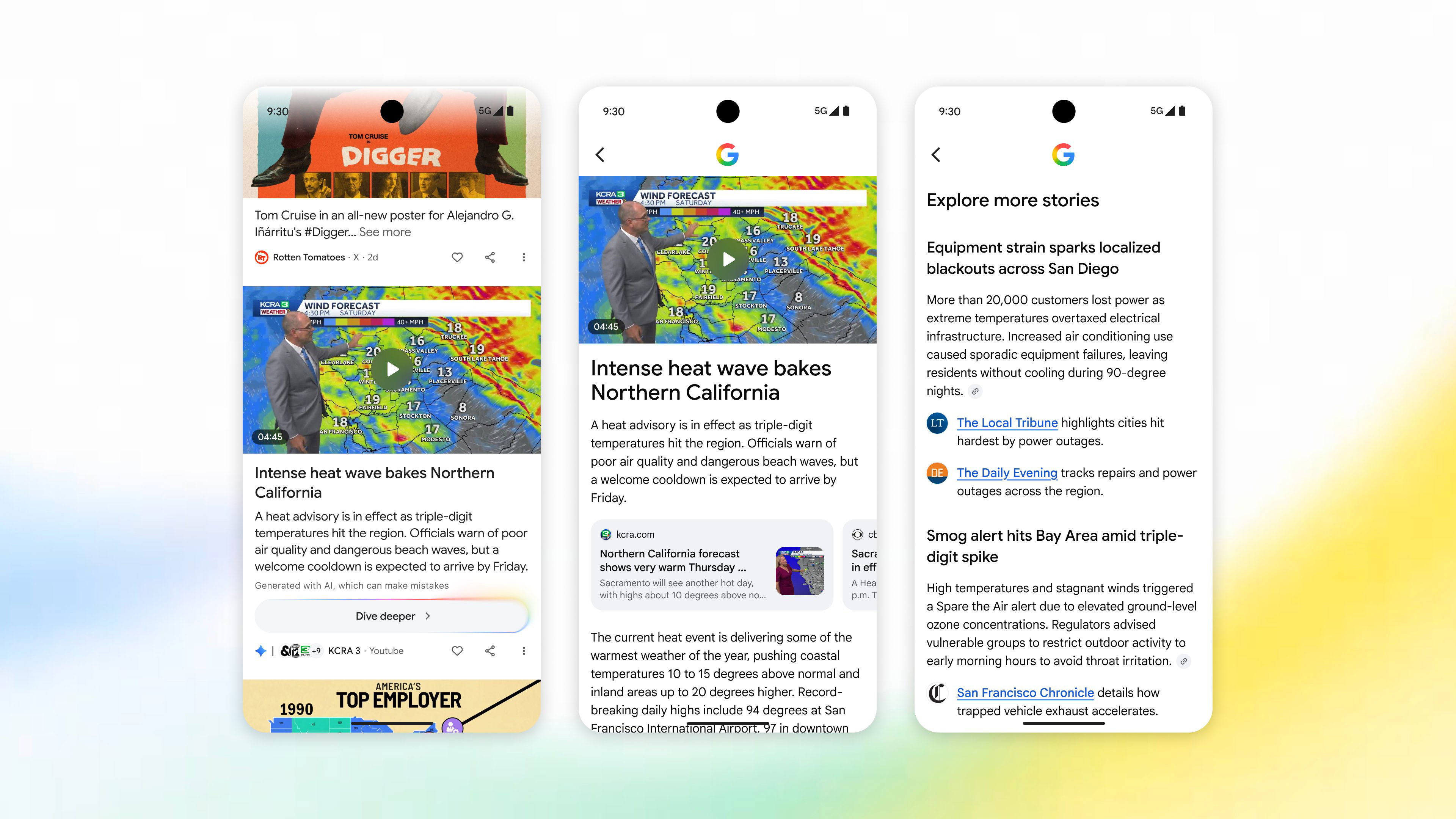
Google is piloting a “Dive Deeper” button in Discover that shows an AI‑generated overview instead of sending users straight to a publisher’s article. The experiment could shift traffic patterns for businesses that rely on Discover, making content structure and local SEO signals more critical than ever.
Key Highlights
- ✓Google Discover’s ‘Dive Deeper’ shows AI‑generated summaries instead of direct article links.
- ✓AI overviews include links to original publisher articles, preserving some traffic flow.
- ✓Local businesses must focus on clear introductions, schema markup, and strong Google Business Profiles.
- ✓Optimizing for AI extraction can improve brand visibility even if click‑through rates shift.
What Happened
Google announced a test of a new feature in Google Discover called Dive Deeper. When users tap the button, they are no longer taken straight to a publisher’s article. Instead, they land on an AI‑generated short overview of the topic, followed by a list of related articles that still link back to the original publishers. The test is currently limited to a handful of users and appears to be part of Google’s broader effort to blend AI‑generated content with traditional web results.
Key Details
- Feature name: Dive Deeper
- Location: Google Discover feed (mobile‑first experience)
- User flow: Click → AI‑generated summary → Links to publisher articles
- Content source: Google’s own language model (likely Gemini/ChatGPT‑style)
- Test scope: Small, opt‑in audience; no public rollout timeline announced
- Community reaction: Mixed – some see it as a convenience, others worry about reduced click‑throughs to original sites
How It Works
1. User sees a Discover card about a topic (e.g., “how to choose a local bakery”).
2. Tap ‘Dive Deeper’. An overlay appears with a concise AI‑written overview (usually 2‑4 paragraphs).
3. Below the overview, Google lists 3‑5 related articles with direct links to the publishers.
4. User can either read the AI summary or click through to a full article for deeper information.
Why Google Is Testing It
- Speed: AI summaries give instant answers, keeping users engaged within the Discover ecosystem.
- Control: Google can surface higher‑quality, vetted content while still crediting original publishers.
- Data: The test lets Google measure how often users stay on the summary versus clicking through, informing future ranking signals.
What It Means For Your Business
1. **Visibility Shifts from Clicks to Summaries**
If Google’s AI summary replaces the direct link, your headline and meta description may no longer be the first thing users see. Instead, the AI will craft the opening paragraph. That makes the clarity of your article’s structure and the prominence of its main points more important than ever.
2. **Citation Opportunities Remain**
The linked articles that appear below the AI overview still drive traffic and can be cited by the AI. Keeping your content well‑structured, with clear headings and schema markup improves the odds that Google pulls relevant snippets and credits you with a link.
3. **Content Optimization for AI Extraction**
Google’s language models favor:
- Clear, concise introductions (the first 2‑3 sentences are prime extraction material).
- Answer‑focused subheadings (e.g., “How to price your services”).
- Bullet‑point lists that are easy to parse.
Optimizing for these elements raises the chance that the AI summary highlights your expertise, boosting indirect brand awareness.
4. **Local SEO Becomes Even More Important**
For small businesses, Google Business Profile (GBP) signals—such as up‑to‑date hours, photos, and reviews—remain a strong ranking factor in Discover. A well‑maintained GBP can appear in the related‑article list, giving you a fallback traffic source even if the AI summary dominates the top of the card.
5. **Strategic Link Building Still Pays Off**
If other publishers reference your content, those backlinks can surface in the AI‑generated list. Earn high‑quality citations from niche blogs, local news sites, and industry directories to keep your brand in the rotation.
Action Checklist for Business Owners
- Audit your top‑performing Discover articles for clear introductions and structured headings.
- Add schema.org Article markup to help Google identify key data points.
- Refresh your Google Business Profile with fresh photos, offers, and Q&A.
- Create concise, bullet‑point “quick‑answer” sections that AI can lift directly.
- Monitor Discover traffic in Google Search Console; watch for changes in click‑through rates (CTR) as the test expands.
Bottom Line
The Dive Deeper experiment signals Google’s intent to blend AI‑generated overviews with traditional web links. For local and small businesses, the shift underscores the need for clear, digestible content and robust local SEO signals. By preparing your articles for AI extraction and maintaining a strong GBP presence, you can stay visible—even when the click path changes.
---
Key Takeaway: Optimize for both humans and machines. The better your content reads to an AI, the more likely it will appear in the new Discover flow, keeping your brand in front of potential customers.
Why It Matters
For businesses that depend on Discover traffic, the Dive Deeper test changes the first point of contact with potential customers. Instead of a headline pulling a user straight to your site, an AI‑crafted summary may be the opening paragraph they read. That makes your article’s opening sentences, subheadings, and bullet points the new “headline” that influences whether a user trusts your brand enough to click through. Poorly structured content could result in a generic AI overview that omits your unique value proposition, weakening brand recall and reducing click‑through rates.
AI‑generated overviews are also likely to be cited in other AI‑driven tools such as ChatGPT, Perplexity, or Gemini when users ask for quick answers. By ensuring your content is well‑structured, uses schema markup, and includes concise answer blocks, you increase the chance those models will quote your site, boosting citation frequency and overall search visibility across multiple AI platforms. In a landscape where AI search is becoming a primary discovery channel, aligning your content strategy with how AI reads and presents information is no longer optional—it’s essential for staying competitive.
FAQs
[{"question":"Will the Dive Deeper feature reduce traffic to my website?","answer":"It may lower click‑through rates for some pages, but Google still provides links to the original articles. Optimizing for AI extraction and keeping a strong Google Business Profile can help offset any traffic loss."},{"question":"How can I make my articles more likely to appear in the AI summary?","answer":"Use clear, concise introductions, descriptive subheadings, bullet‑point lists, and schema.org markup. These elements guide the AI to the most important points for its overview."},{"question":"Is there anything I can do to influence the AI‑generated overview?","answer":"You can’t control the AI directly, but you can shape its output by structuring your content for easy parsing, answering common questions early, and ensuring the information is high‑quality and authoritative."}]
Why This Matters For Your Business
For businesses that rely on Discover traffic, the *Dive Deeper* test reshapes the initial user experience. Instead of a headline that sends a user straight to a site, an AI‑written summary becomes the first thing they read, turning the article’s opening sentences, subheadings, and bullet points into the new “headline.” If those elements are weak or vague, the AI may produce a generic overview that skips your unique selling points, reducing brand recall and click‑through rates. Because AI‑generated overviews can be reused by other AI assistants—ChatGPT, Perplexity, Gemini, and similar tools—well‑structured content that includes schema markup and concise answer blocks can earn citations beyond Discover. Those citations amplify visibility across multiple AI‑driven search experiences, making it crucial for businesses to align their content strategy with how AI extracts and presents information.
Frequently Asked Questions
Will the Dive Deeper feature reduce traffic to my website?
It may lower click‑through rates for some pages, but Google still provides links to the original articles. Optimizing for AI extraction and keeping a strong Google Business Profile can help offset any traffic loss.
How can I make my articles more likely to appear in the AI summary?
Use clear, concise introductions, descriptive subheadings, bullet‑point lists, and schema.org markup. These elements guide the AI to the most important points for its overview.
Is there anything I can do to influence the AI‑generated overview?
You can’t control the AI directly, but you can shape its output by structuring your content for easy parsing, answering common questions early, and ensuring the information is high‑quality and authoritative.
Is your business showing up in AI search?
Get your free AI visibility audit - see if ChatGPT, Perplexity, and Google AI actually recommend you.