
Home / News / Google Gemini Drops UTM Tags—What It Means for AI‑Driven Local Visibility
Google Gemini Drops UTM Tags—What It Means for AI‑Driven Local Visibility
Google Gemini has stopped appending utm_source=gemini tags to cited URLs, meaning traffic from the AI chat no longer carries the standard UTM signal. This change forces local businesses to adopt alternative tracking methods to maintain accurate attribution of AI‑driven traffic. Understanding the shift helps owners adjust their analytics and reporting strategies.
Key Highlights
- ✓Gemini stopped adding utm_source=gemini tags to cited URLs
- ✓Referrer headers from gemini.google.com remain but lack UTM data
- ✓Local businesses lose clear traffic attribution from AI answers
- ✓Businesses can adapt with custom tracking and server‑log analysis
What Happened
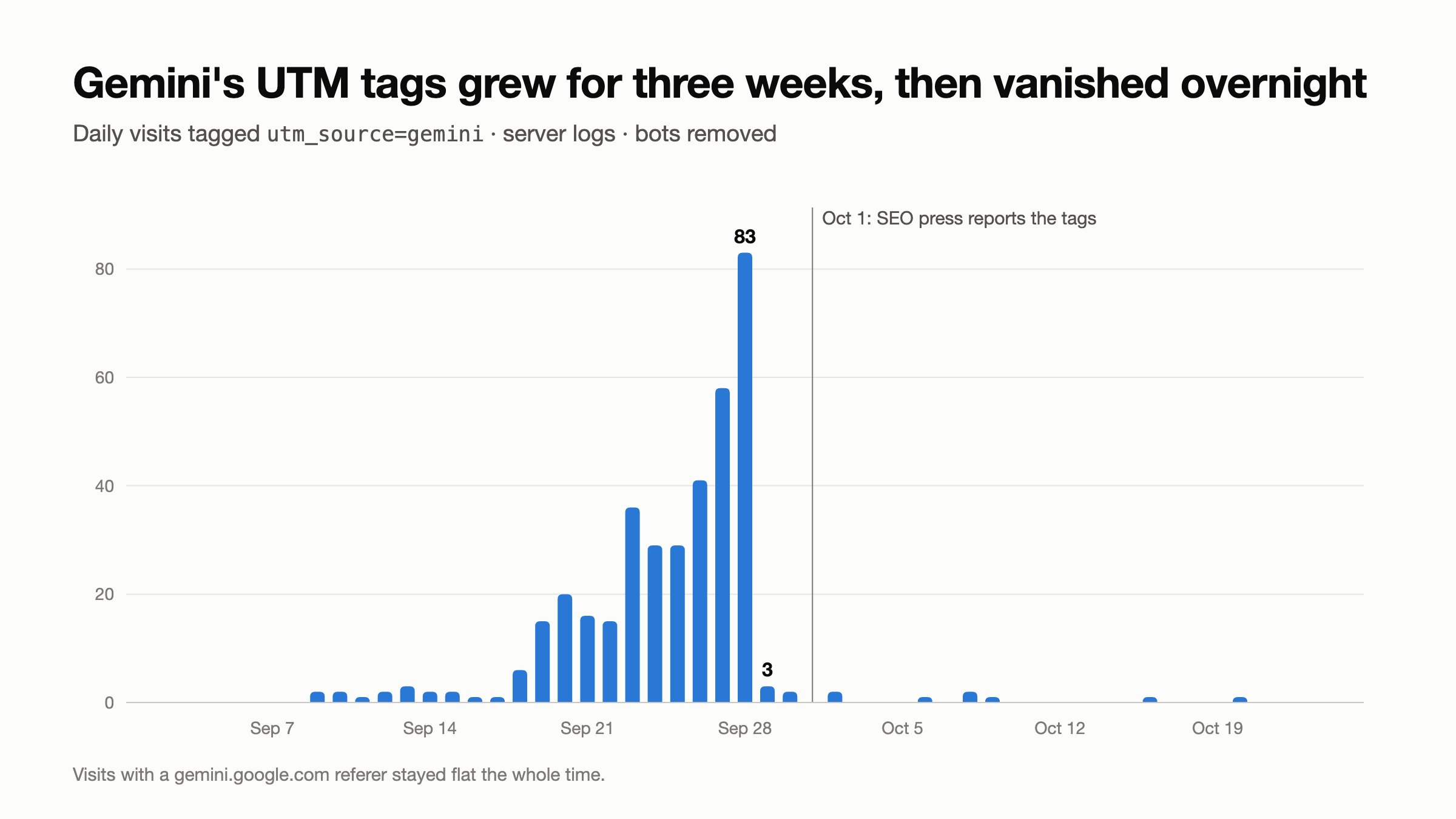
Google Gemini, the AI chat platform that powers answers in Google Search, recently stopped appending UTM parameters to the URLs it cites in its responses. The change was first noticed in early September when Gemini began adding a utm_source=gemini tag to every link it referenced. By the end of September, however, those tags disappeared overnight, leaving many marketers puzzled.
The UTM parameter was a simple way for Gemini to signal to webmasters and analytics platforms that a click originated from the AI assistant. With the tag gone, the referral data that Gemini previously sent via UTM is now missing, even though the referrer header still shows gemini.google.com on the desktop version.
Key Details
- Timeline:
- Early September: Gemini starts appending utm_source=gemini to cited URLs.
- September 28: The UTM tags vanish overnight.
- What’s still happening: Referrer headers from gemini.google.com remain unchanged on desktop, but the UTM parameter is no longer present.
- Why it matters: UTM parameters are the standard way to track traffic sources in Google Analytics, Adobe Analytics, and other platforms. Their removal means that clicks from Gemini can no longer be automatically labeled as “Gemini.”
- Official comments: Google’s John Mueller acknowledged the change on X, suggesting that the removal is part of an ongoing refinement of Gemini’s tracking strategy.
- Potential impact on citations: Local businesses that rely on AI‑generated citations for visibility may find their traffic attribution less precise, making it harder to measure the ROI of AI‑driven traffic.
What It Means For Your Business
1. Tracking Loss
Without UTM tags, your analytics tools no longer receive a clear signal that a visitor came from Gemini. This can lead to:
- Under‑reported traffic: Sessions that actually originated from Gemini may be counted as organic or direct.
- Misattributed conversions: Conversions driven by AI answers might be incorrectly attributed to other channels.
- Harder optimization: You’ll struggle to understand which AI queries bring the most value.
2. Citation Visibility
Gemini’s cited URLs are a major source of traffic for local businesses. The removal of UTM tags does not affect the link itself, but it does remove a layer of transparency that helps you prove the value of AI citations to stakeholders.
3. Adaptation Strategies
- Use custom tracking URLs: Add your own UTM parameters to the links you provide in your content or marketing materials.
- Leverage server logs: Inspect referrer headers to identify Gemini traffic.
- Ask Gemini to re‑add tags: Contact Google support or provide feedback on the Gemini Help Center.
- Employ link shorteners: Services like Bitly can add custom tags and give you click analytics.
- Focus on overall attribution models: Use multi‑touch attribution to capture AI traffic even without explicit UTM tags.
4. Long‑Term Implications
The shift signals that Google is refining how it tracks AI traffic. While this may reduce the granularity of data for now, it also opens the door for more sophisticated attribution models that go beyond simple UTM tags. Staying ahead will require businesses to diversify their tracking and rely more on holistic analytics.
Why It Matters
UTM parameters were the primary mechanism for local businesses to prove that visits and conversions were coming from AI‑generated answers. Without this signal, attributed sessions drop and conversion attribution blurs, making it harder to justify AI‑driven marketing spend. Accurate attribution is essential for optimizing local SEO budgets and reporting to stakeholders, especially as AI becomes a dominant discovery channel.
The removal also signals Google’s ongoing refinement of Gemini’s tracking strategy, hinting that future attribution models may become more sophisticated. Businesses that adapt early by implementing custom tracking URLs, server‑side referrer analysis, or link‑shortening services will retain visibility into AI traffic and be better positioned to refine their strategies based on real data.
FAQs
Q1: Will the removal of UTM tags affect my SEO rankings?
A1: No. UTM parameters are for analytics only and do not influence how search engines rank your pages. Your SEO performance should remain unchanged.
Q2: How can I still track Gemini traffic without UTM tags?
A2: Monitor referrer headers in your analytics or server logs, use custom tracking URLs, and consider link shorteners that offer click analytics.
Q3: Is there a way to get Google to reinstate the UTM tags?
A3: You can provide feedback through the Gemini Help Center or contact Google support. However, there’s no guarantee that the feature will return.
Why This Matters For Your Business
UTM parameters were the primary mechanism for local businesses to prove that visits and conversions were coming from AI‑generated answers. Without this signal, attributed sessions drop and conversion attribution blurs, making it harder to justify AI‑driven marketing spend. Accurate attribution is essential for optimizing local SEO budgets and reporting to stakeholders, especially as AI becomes a dominant discovery channel. The removal also signals Google’s ongoing refinement of Gemini’s tracking strategy, hinting that future attribution models may become more sophisticated. Businesses that adapt early by implementing custom tracking URLs, server‑side referrer analysis, or link‑shortening services will retain visibility into AI traffic and be better positioned to refine their strategies based on real data.
Frequently Asked Questions
Will the removal of UTM tags affect my SEO rankings?
No. UTM parameters are for analytics only and do not influence how search engines rank your pages. Your SEO performance should remain unchanged.
How can I still track Gemini traffic without UTM tags?
Monitor referrer headers in your analytics or server logs, use custom tracking URLs, and consider link shorteners that offer click analytics.
Is there a way to get Google to reinstate the UTM tags?
You can provide feedback through the Gemini Help Center or contact Google support. However, there’s no guarantee that the feature will return.
Is your business showing up in AI search?
Get your free AI visibility audit - see if ChatGPT, Perplexity, and Google AI actually recommend you.