
Home / News / Google LSAs Show Business Profile Numbers Instead of Ads Numbers
Google LSAs Show Business Profile Numbers Instead of Ads Numbers
Google’s recent update forces Local Services Ads to pull the phone number from the linked Google Business Profile, overriding any call‑tracking number set in Google Ads. This shift changes call attribution, alters cost‑per‑call metrics, and aligns the number shown in LSAs with the one used by AI assistants and other search tools.
Key Highlights
- ✓Google LSAs now use GBP phone number instead of Ads call tracking number
- ✓Loss of granular call attribution in Google Ads dashboards
- ✓Improved consistency for AI assistants but gaps in tracking data
- ✓Solutions: sync numbers, use third‑party tracking, and VisibilityAI citations
What Happened
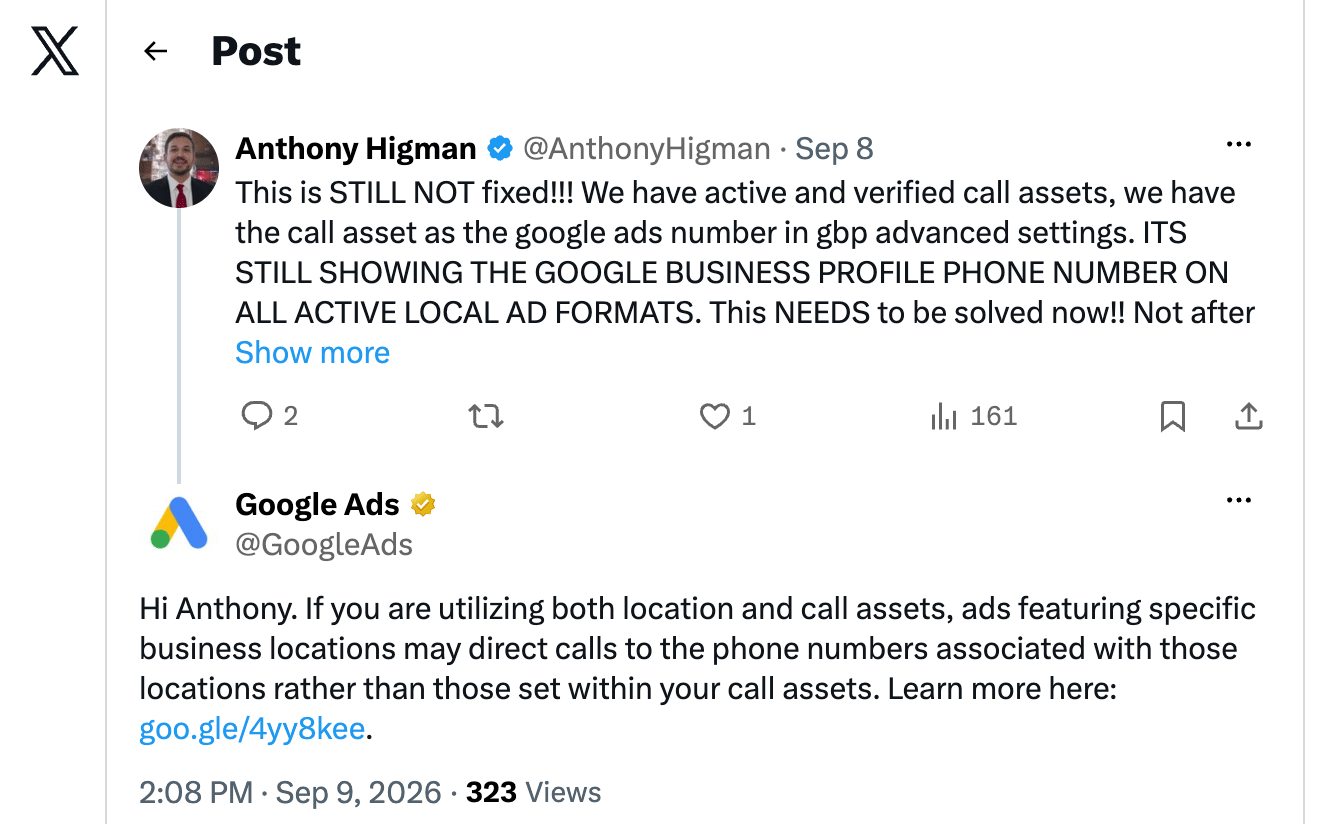
Google has changed the way phone numbers are selected for Local Services Ads (LSAs). Even if you set up a dedicated Google Ads call‑tracking number, the ad now shows the phone number listed on the associated Google Business Profile (GBP). Google’s support team confirmed the behavior, and the company posted a public note on X (formerly Twitter). The update applies to every LSA that combines location and call assets.
Key Details
- Trigger: The switch happens automatically; no new campaign setting is required.
- Scope: It affects both desktop and mobile LSA listings, including the “Call Now” button and the phone number that appears in the ad copy.
- Source: Google Ads explains, “If you are utilizing both location and call assets, ads featuring specific business locations may direct calls to the phone numbers associated with those locations rather than those set within your call assets.”
- Tracking Impact: Calls that reach the GBP number bypass Google Ads’ call‑tracking system, making it harder to tie a conversion to a specific ad.
- Work‑around: Some advertisers add a secondary call asset that mirrors the GBP number, or they employ a third‑party call‑tracking service that can overwrite the displayed number.
What It Means For Your Business
Local businesses that depend on LSAs for phone leads should expect a direct impact on attribution, cost‑per‑call, and overall ROI. Because calls now flow through the GBP number, the detailed call‑tracking data normally available in Google Ads disappears. The consequences are:
- Reduced Visibility: The Google Ads dashboard no longer indicates which LSA triggered an individual call.
- Potential Cost Shifts: When a call is no longer counted as a click‑to‑call event, the cost‑per‑call metric may change, affecting bidding strategies.
- SEO & AI Discovery: Displaying the same number in LSAs and the GBP improves consistency across Google Maps, search results, and AI assistants that pull data from your profile.
How to Adapt
1. Sync Numbers: Make sure the phone number on your GBP is the one you want to track.
2. Use Call Assets Wisely: If you need a separate tracking number, create an additional call asset that points to your call‑tracking provider.
3. Monitor Calls Manually: Implement manual call logs or adopt a third‑party platform that can capture inbound calls to the GBP number.
4. Leverage AI‑Powered Citations: Tools like VisibilityAI can keep your business information uniform across AI platforms, helping offset the loss of granular tracking.
Impact on AI‑Powered Search
AI assistants such as ChatGPT, Perplexity, Gemini, and Google AI often retrieve contact details directly from a GBP. With LSAs now showing the same number, users experience a unified contact point across search and voice interfaces. The trade‑off is a reduction in call‑tracking insights, so consider using third‑party analytics that can tag inbound calls with the originating AI platform.
Best Practices Going Forward
- Regularly Audit Your GBP: Keep phone numbers, hours, and services up‑to‑date.
- Use Structured Data: Add schema markup for contact information to reinforce consistency across the web.
- Explore Call‑Tracking APIs: Integrate services that log calls regardless of the displayed number.
- Educate Your Team: Ensure marketing and operations understand the new phone‑number flow so leads are handled promptly.
Future Outlook
Google has indicated that the change is permanent; support representatives confirmed there are no plans to roll it back. Monitor performance metrics closely and adjust bidding strategies as needed. If ROI suffers, diversify your local marketing mix with organic rankings, review generation, and direct website lead forms.
Takeaway
- Keep your GBP data accurate and consistent.
- Deploy third‑party call‑tracking to regain attribution.
- Use VisibilityAI to automate citation updates across AI platforms.
Why It Matters: For businesses that rely on local search visibility, the phone number is often the first point of contact with a potential customer. When LSAs pull the number from the GBP instead of a dedicated tracking number, you lose the ability to see which ad or keyword generated that call, making it harder to optimize spend and gauge ROI. At the same time, AI assistants and generative search tools increasingly depend on GBP data. Ensuring the number in your profile is correct provides a seamless experience for users discovering your business through AI‑driven queries, even though you may miss some actionable insights without proper tracking. In short, the update forces local marketers to balance consistent, AI‑friendly contact information with the need for detailed conversion data.
Why This Matters For Your Business
For most local businesses, the phone number displayed in search results is the first interaction a prospect has with the brand. By defaulting LSAs to the Google Business Profile number, Google eliminates the dedicated call‑tracking number that advertisers previously relied on to pinpoint which ad, keyword, or campaign generated a call. The loss of that granularity makes it more difficult to fine‑tune budgets, evaluate ROI, and justify spend to stakeholders. Conversely, the alignment of the LSA number with the GBP improves data consistency across Google Maps, organic listings, and AI assistants such as ChatGPT or Google AI. When AI tools pull contact details from a single, authoritative source, users receive a uniform experience, which can boost trust and conversion rates. However, without a robust third‑party tracking solution, marketers may miss valuable insights about how AI‑driven queries translate into phone leads. In practice, the change pushes local marketers to adopt a dual strategy: keep the GBP information flawless for AI and user experience, while layering on external call‑tracking services to regain the attribution data needed for performance optimization.
Frequently Asked Questions
Does this affect all Local Services Ads?
Yes. Any LSA that uses both location and call assets will now display the phone number from the associated Google Business Profile.
Can I still use a call‑tracking number?
You can add a secondary call asset that matches the GBP number or employ a third‑party call‑tracking service that overwrites the displayed number.
Will this impact my Google Ads cost?
Calls routed through the GBP number may no longer be counted as click‑to‑call events, which can alter your cost‑per‑call metric.
Is your business showing up in AI search?
Get your free AI visibility audit - see if ChatGPT, Perplexity, and Google AI actually recommend you.