
Home / News / Google Maps Requires Sign‑In to See All Reviews – Impact on Local SEO
Google Maps Requires Sign‑In to See All Reviews – Impact on Local SEO
Google Maps now requires users to sign in to access full reviews, sort options, and the ability to write new reviews. This change aims to combat data scraping while reshaping how customers interact with local businesses online.
Key Highlights
- ✓Google Maps now requires a Google account to view all reviews.
- ✓The change targets AI scraping, bots, and third‑party data mining.
- ✓Limited review visibility may affect AI‑generated search results.
- ✓Businesses must encourage signed‑in reviews and strengthen structured data.
What Happened
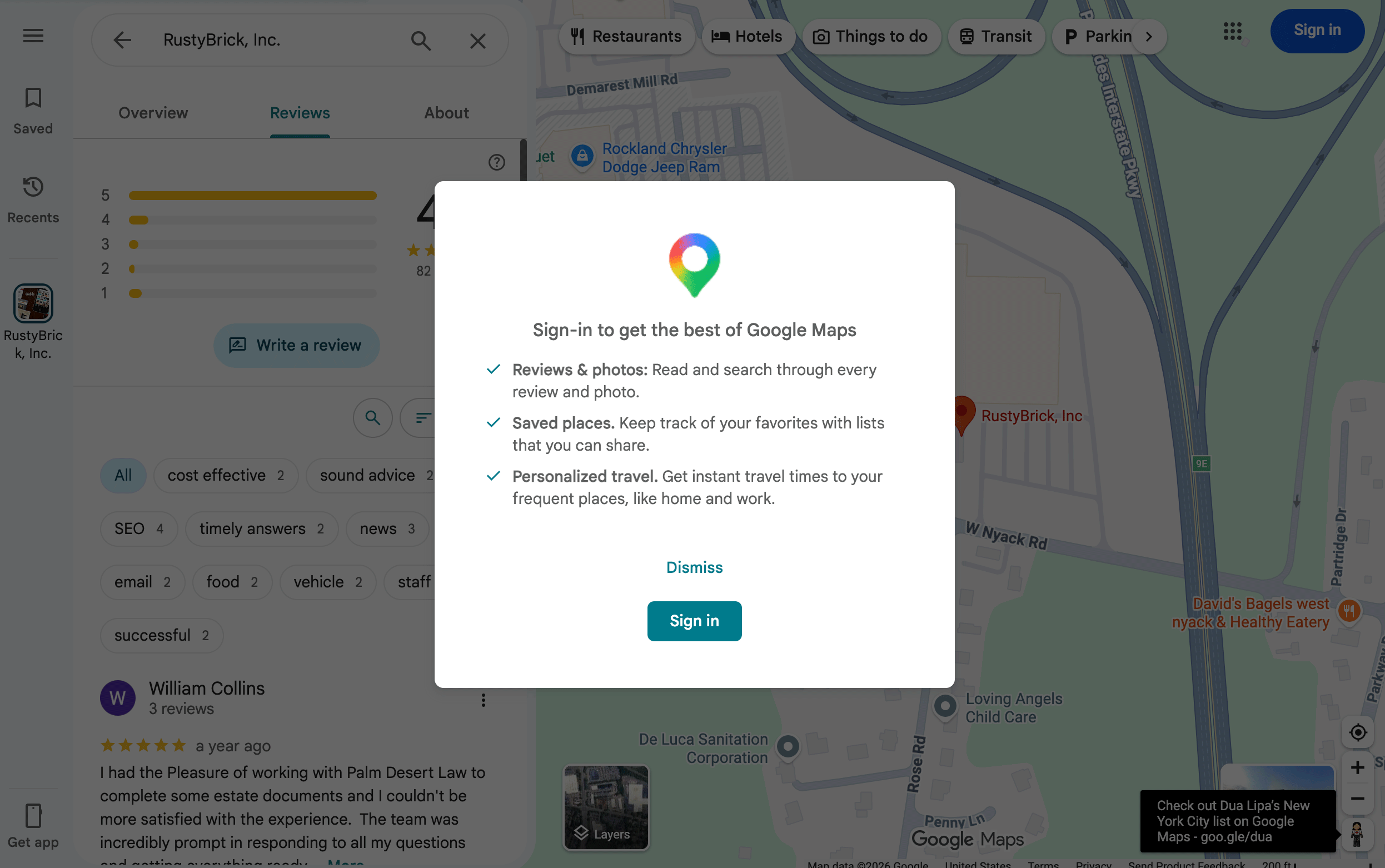
On September 30, 2026, Google announced that all users must be signed into a Google account to view the complete set of reviews on a Google Business Profile. This new requirement affects the functionality of the “see more reviews” button, review sorting options, and the ability to submit new reviews. Users will now encounter a prompt encouraging sign-in, which highlights benefits such as access to “Reviews & photos, Saved places, Personalized travel.”
This initiative appears primarily aimed at thwarting AI-driven scraping tools, bots, and third-party services that gather review data for training purposes or competitive analysis.
---
Key Details
- Scope: This restriction encompasses all Google Maps listings utilizing a Google Business Profile. While anonymous users can still view a limited selection of the most recent or highest-rated reviews, accessing the full review archive now requires signing in.
- Features Affected:
- The "See more reviews" button
- Review sorting options (e.g., most recent, highest rating)
- The ability to write a new review or upload photos
- User Experience: A pop-up message encourages users to “Sign in to get the best of Google Maps.” This prompt includes a short animation showcasing the advantages of logging in.
- Reasoning (per Google): This change aims to safeguard user-generated content, enhance personalization, and mitigate the risk of automated scraping that supports AI models and data-mining services.
- Timing: The update was rolled out globally within hours of the announcement, impacting both desktop and mobile users.
---
What It Means for Your Business
1. **Reduced Visibility for Anonymous Shoppers**
When potential customers cannot access the complete review history, their trust in your business may wane. Reviews serve as vital social proof for both consumers and AI assistants that present local results.
2. **Impact on AI-Powered Search Tools**
AI tools like ChatGPT, Perplexity, Gemini, and Google AI Overviews rely on publicly available information. With Google Maps concealing reviews behind a login wall, these AI models will only have access to a limited dataset, which could diminish your business's visibility in AI-generated responses.
3. **Opportunity for Authentic Engagement**
The sign-in requirement means that users must have a Google account, allowing you to target them more effectively through Google Business Profile posts, special offers, and Q&A. Engaged, logged-in users are generally more inclined to convert.
4. **Increased Importance of Structured Data**
As reviews become less accessible to crawlers, employing schema markup (such as Review and AggregateRating) on your website becomes even more crucial. This markup serves as a reliable source of rating information for search engines and AI tools.
---
Actionable Steps for Business Owners & Marketers
- Encourage Customers to Sign In: Motivate satisfied customers to log into their Google accounts before posting reviews. Simple in-store signage or follow-up emails with direct links can significantly increase the volume of signed-in reviews.
- Leverage Google Posts: Utilize the Google Business Profile’s posting feature to share updates, promotions, and snippets of positive reviews. These posts appear directly in the knowledge panel and are accessible to all users.
- Optimize On-Site Review Widgets: Embed a Google Review widget on your website that aggregates the latest reviews (via the API, which adheres to the sign-in requirement). This keeps valuable content visible to site visitors and search engines.
- Strengthen Structured Data: Ensure your site includes comprehensive
ReviewandAggregateRatingschema. Include details such as author names, dates, and rating values to provide search engines with a dependable reference. - Monitor AI Citations: Set up alerts for mentions of your business in AI-generated content (using tools like VisibilityAI). If citations decrease, consider enhancing your presence on other citation platforms like Yelp, TripAdvisor, or industry-specific directories.
- Diversify Review Sources: Encourage reviews on platforms that remain fully public, such as Facebook and Trustpilot. A well-rounded review ecosystem reduces dependence on a single source like Google.
- Stay Informed: Keep up with Google's official announcements and community forums. Future updates may modify the sign-in requirement or introduce new APIs.
---
Bottom Line
The new sign-in mandate on Google Maps indicates that Google is tightening its grip on its review ecosystem. Although this may initially seem like an obstacle, astute businesses can leverage this change to their advantage by fostering authentic, logged-in reviews, reinforcing structured data, and broadening their presence across various citation platforms.
For businesses reliant on AI tools for visibility, this shift highlights the necessity of multi-channel visibility and data hygiene. By adapting proactively, you can maintain or even enhance your chances of being discovered and cited by the next generation of AI-driven search experiences.
Why This Matters For Your Business
For businesses that rely on being found through AI assistants like ChatGPT or Gemini, the review data provided by Google Maps serves as a crucial ranking signal. When this data becomes inaccessible behind a sign-in wall, AI models only receive a partial view, which can negatively impact your business's visibility in AI-generated results. By ensuring a healthy volume of reviews from logged-in users, you can maintain a strong signal and enhance your visibility across both traditional search engines and emerging AI interfaces. Moreover, this transition emphasizes the need for marketers to diversify their citation strategy. Relying solely on Google reviews is no longer sufficient; establishing a robust presence on alternative review platforms, alongside implementing effective schema markup on your own site, is now essential. This multi-source approach safeguards against potential policy changes and strengthens the overall trustworthiness of your brand in both human and machine assessments.
Frequently Asked Questions
Will anonymous users still see any reviews on my Google Business Profile?
Yes, while a limited set of recent or highly-rated reviews will remain visible, the complete archive and sorting options will be hidden until the user signs in.
Does this affect the ability to reply to reviews as a business owner?
No, business owners can still respond to reviews through the Google Business Profile dashboard, which already requires a sign-in.
How can I encourage more customers to leave signed-in reviews?
Send follow-up emails with a direct link to the review page, display in-store signage prompting a Google sign-in, and consider offering incentives (e.g., discounts) for leaving a review after logging in.
Is your business showing up in AI search?
Get your free AI visibility audit - see if ChatGPT, Perplexity, and Google AI actually recommend you.