
Home / News / Google Recommends Manual Fact‑Checking of AI Content
Google Recommends Manual Fact‑Checking of AI Content
Google now requires webmasters to manually fact‑check any AI‑generated content before publishing, aiming to curb hallucinations. The guidance affects local businesses, SEO strategies, and visibility in AI‑driven search tools. Following the recommendation helps preserve credibility and maintain rankings.
Key Highlights
- ✓Google urges manual fact‑checking of AI content
- ✓Hallucinations arise because AI predicts rather than retrieves facts
- ✓No penalty yet, but accuracy boosts rankings
- ✓Local businesses must audit AI content for credibility
What Happened
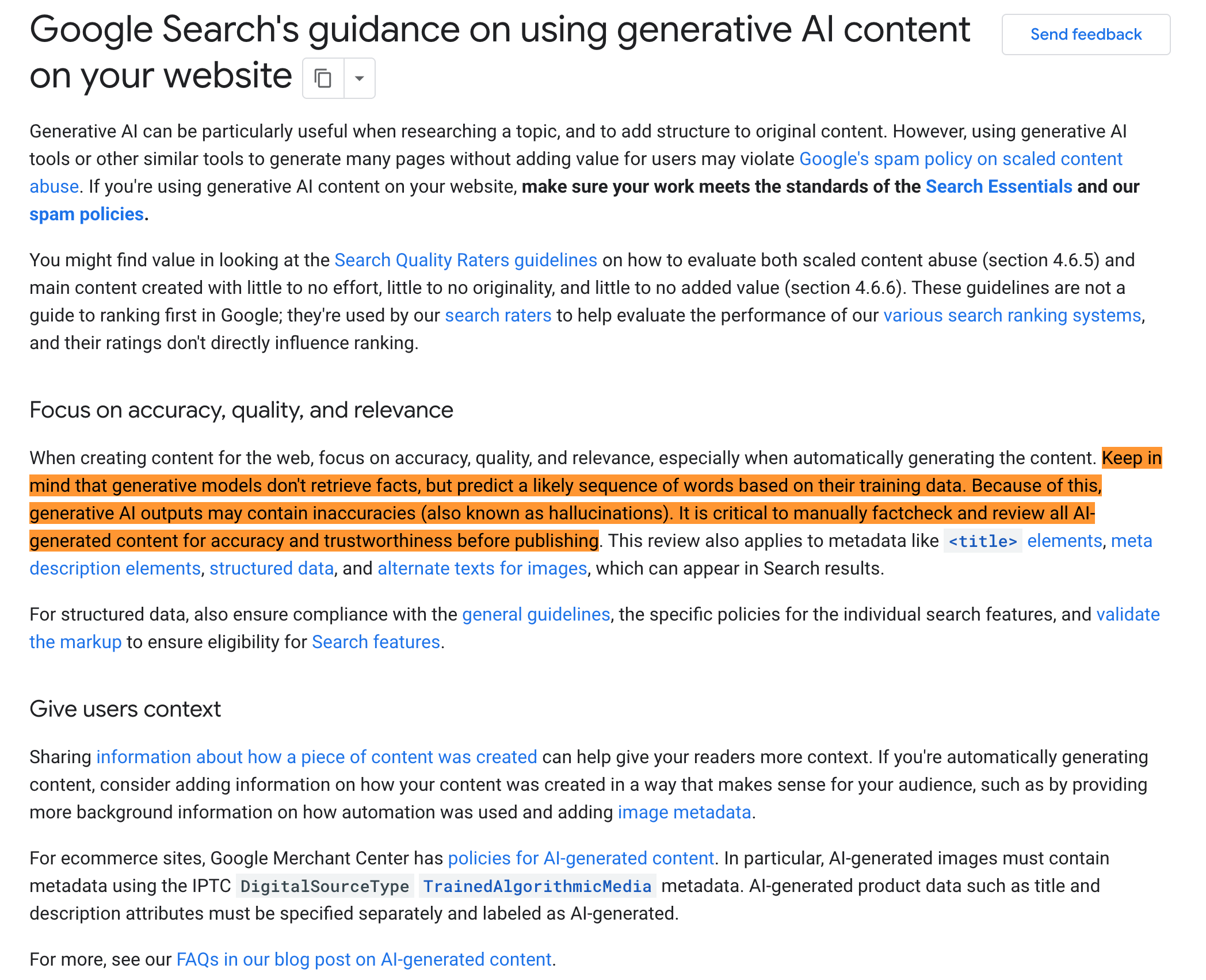
Google has refreshed its "Using Generative AI Content on Your Website" help page. The updated guidance makes it clear that site owners must manually fact‑check and review every piece of AI‑generated content for accuracy and trustworthiness before it goes live. The move follows a wave of AI‑written articles that contain hallucinations—fabricated facts that can mislead readers.
Announced on October 1, 2026, the change is part of Google’s broader push to raise the quality of search results that feature generative‑AI material. It is presented as a best‑practice recommendation rather than a formal penalty, aligning with Google’s pledge to surface reliable information.
Key Details
- Fact‑checking is mandatory: Google describes verification as critical for anyone publishing AI‑generated text.
- Hallucinations explained: AI models generate word sequences from their training data instead of pulling real‑time facts, which can lead to inaccurate statements.
- No direct penalty: While the update does not introduce a new sanction, pages that contain false information may still see rankings dip.
- Applies to all AI‑generated material: Whether you’re producing blog posts, product descriptions, FAQs, or any other content with generative AI, the rule applies.
- Best‑practice checklist:
* Verify facts against reputable sources.
* Cross‑check dates, statistics, and names.
* Ensure citations are current.
* Review tone and style for consistency.
- Impact on local SEO: Trustworthy, accurate content is a ranking factor, especially for queries with local intent.
- AI search relevance: Tools like ChatGPT, Gemini, and other AI assistants prioritize well‑cited, fact‑checked pages when surfacing answers.
What It Means For Your Business
1. Maintain credibility – Local customers depend on precise information when selecting nearby services; a single error can erode trust.
2. Boost search visibility – Google rewards high‑quality, accurate content, giving fact‑checked AI output a competitive edge in SERPs.
3. Improve AI search performance – AI assistants draw from indexed pages and favor content that includes verifiable citations.
4. Reduce risk of misinformation fallout – Even without a hard penalty, inaccurate material can lead to lower rankings and user disengagement.
Practical Steps for Small Businesses
- Audit existing AI content: Conduct a swift review of every AI‑generated page on your site.
- Use fact‑checking tools: Services such as FactCheck.org or Snopes can help verify claims quickly.
- Add citations: Link to primary sources, government data, or reputable industry reports.
- Train staff: Make sure your content team understands why verification matters.
- Schedule regular reviews: Implement a quarterly audit cycle for all AI‑generated material.
How VisibilityAI Can Help
VisibilityAI specializes in getting local businesses noticed by AI tools. Our services include:
- Auditing your AI content for factual accuracy.
- Optimizing citations so AI assistants can reliably reference your business.
- Enhancing local schema markup to improve AI visibility.
- Providing ongoing monitoring to keep your content trustworthy over time.
By embracing Google’s new guidance and partnering with a local‑SEO platform like VisibilityAI, you can turn AI‑generated content into a strategic advantage rather than a liability.
Why It Matters: In today’s AI‑driven search landscape, assistants such as ChatGPT, Gemini, and Google AI pull from the web to answer user queries. When these tools surface inaccurate or fabricated information, they risk misleading consumers and harming brand reputation. For local businesses, credibility is essential; a single mistake in an AI‑generated FAQ or product description can cause customers to doubt the entire service.
Moreover, Google’s quality algorithms increasingly reward factual accuracy. Although the update does not impose a hard penalty, pages that consistently present verified facts will rank higher and appear more often in both organic results and AI‑assistant answers. This translates directly into more traffic, higher conversion rates, and a stronger local presence.
By proactively fact‑checking AI content, you not only follow Google’s recommendation but also position your business as a reliable source—an attribute that matters to both human readers and AI tools that prioritize trustworthy information.
Why This Matters For Your Business
AI assistants now draw directly from web pages to answer questions, so any misinformation they relay can quickly spread to many users. For local businesses, a single erroneous fact in an AI‑generated FAQ or description can undermine confidence and drive potential customers away. Google’s ranking signals are evolving to value factual accuracy more heavily. While the latest update does not create a formal penalty, pages that repeatedly publish unverified claims are likely to slip in rankings, reducing visibility in both traditional search and AI‑driven results. Ensuring that AI‑generated content is thoroughly vetted therefore protects brand reputation and sustains traffic growth.
Frequently Asked Questions
Do I have to manually fact‑check every AI‑generated page?
Yes. Google advises reviewing all AI‑generated content before it goes live, even minor updates or short pieces should be verified.
Will inaccurate AI content get penalized?
There is no explicit penalty at this time, but inaccurate material can cause rankings to fall and erode user trust.
How can I efficiently verify AI content?
Consult reputable fact‑checking sites, cross‑reference official statistics, and add citations to primary sources. Automation tools can also flag potential errors for manual review.
Is your business showing up in AI search?
Get your free AI visibility audit - see if ChatGPT, Perplexity, and Google AI actually recommend you.