
Home / News / Googlebot Now Follows Home‑Page Redirects to Favicons – What It Means for Local SEO
Googlebot Now Follows Home‑Page Redirects to Favicons – What It Means for Local SEO
Google’s updated favicon guide now requires Googlebot to follow any redirects from a site’s homepage to the favicon file and forbids blocking that file with robots.txt. Small businesses should verify their redirect chains and robots.txt rules so AI‑driven tools can reliably display their brand icon.
Key Highlights
- ✓Googlebot must follow homepage redirects to favicon
- ✓Robots.txt cannot block favicon or redirect URLs
- ✓Impacts AI assistants like ChatGPT, Gemini, and Google AI
- ✓Ensures consistent brand icon across search results and citations
# Googlebot Must Follow Redirects From Homepage To Favicon, Updated Doc Say
Oct 27, 2026 - 3:05 pm
[0](https://www.seroundtable.com/googlebot-redirects-from-homepage-to-favicon-42396.html#comments)
—
by [Barry Schwartz](https://www.seroundtable.com/author/barry-schwartz/2.html)
[Barry Schwartz\ / Executive Editor](https://www.seroundtable.com/author/barry-schwartz/2.html)
[](https://www.seroundtable.com/author/barry-schwartz/2.html)
Barry Schwartz is the CEO of [RustyBrick](http://www.rustybrick.com/) and a technologist, a New York Web service firm specializing in customized online technology that helps companies decrease costs and increase sales. Barry is also the founder of the [Search Engine Roundtable](https://www.seroundtable.com/) and the News Editor of [Search Engine Land](http://searchengineland.com/). He is well known & respected for his expertise in the search marketing industry. He only provides consulting services to expert SEOs and also performs [search marketing expert witness](https://www.rustybrick.com/sem-expert-witness.html) services. Barry graduated fr
What Happened
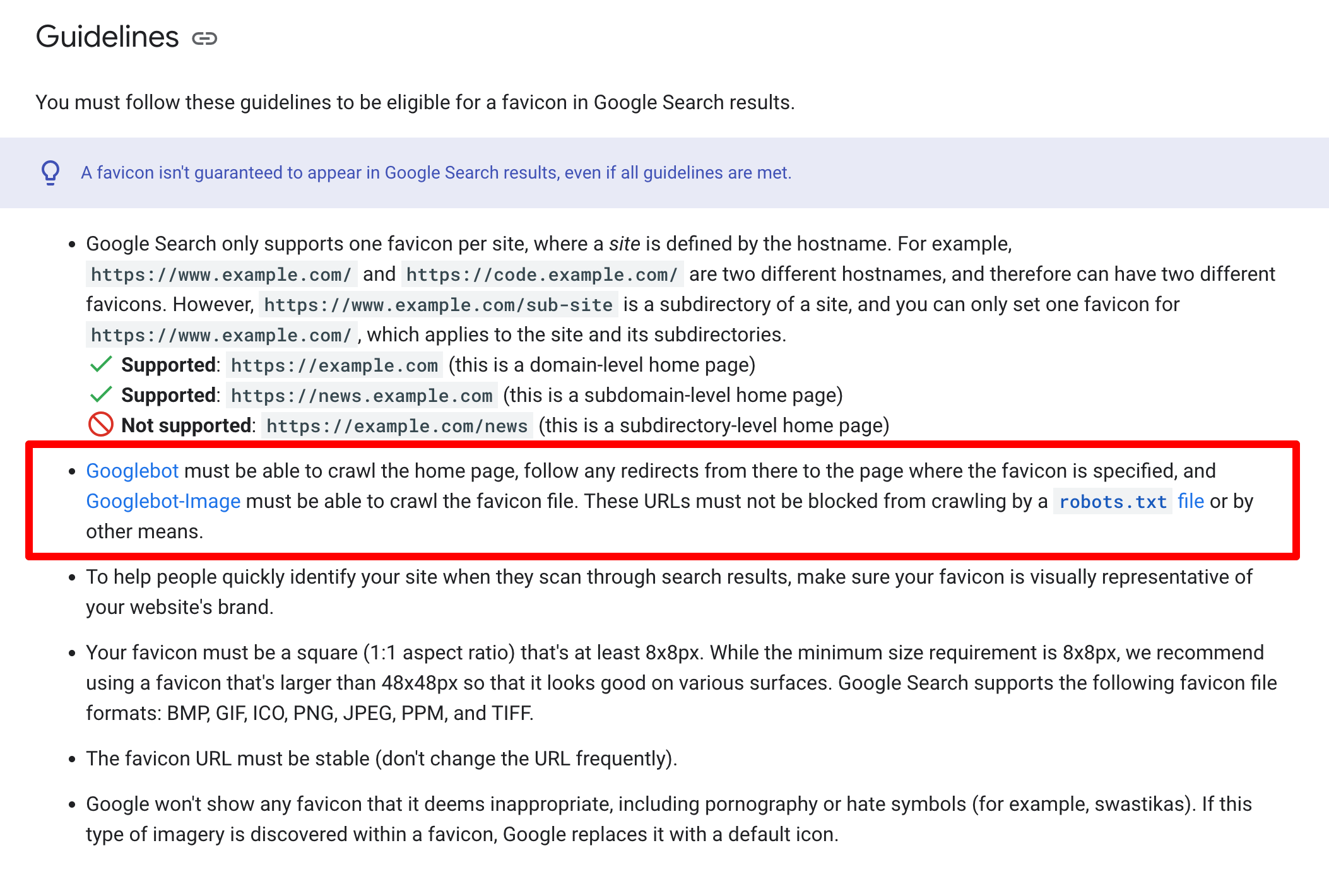
Google recently refreshed its [favicon documentation](https://developers.google.com/search/docs/appearance/favicon-in-search) to state that Googlebot must be able to crawl the homepage, follow any redirects from that page to the location where the favicon is declared, and that the favicon itself cannot be blocked by robots.txt or any other restriction.
While the requirement sounds straightforward, it creates a cascade of implications for search platforms—particularly AI‑driven assistants such as ChatGPT, Perplexity, Gemini, and Google AI—that pull brand icons from search results.
Key Details
- Redirects are now required: If your homepage forwards visitors (for example, to a sub‑folder or a language‑specific version), the entire redirect chain must ultimately lead to the favicon URL.
- Robots.txt must not block: Both the favicon URL and any intermediate URLs in the redirect path need to be allowed for Googlebot and Googlebot‑Image.
- Image crawling: Googlebot‑Image still fetches the favicon file itself, so the file must be reachable without restriction.
- No prior redirect rule: Earlier documentation only demanded that Googlebot reach the homepage and the favicon file directly; it never required the redirect path to be crawlable.
Practical Checklist
- Confirm that your homepage address (e.g.,
https://www.yourbiz.com) does not redirect to a page that disallows Googlebot. - Run the redirect chain through Google Search Console’s URL Inspection tool to verify crawlability.
- Amend any
robots.txtdirectives that could inadvertently block the redirect URLs or the favicon itself. - Store the favicon in a simple location such as
/favicon.icoor reference it clearly with an HTML<link>tag.
What It Means For Your Business
1. **AI Search Visibility**
AI assistants extract data from SERP snippets, and the favicon often serves as the visual identifier for a brand. If Googlebot cannot retrieve the icon, AI tools may fall back to a generic placeholder or omit the image entirely, weakening brand recall.
2. **Citation Consistency**
Local‑listing services and citation platforms embed favicons in their interfaces. A broken favicon chain can cause missing or incorrect icons, making your online presence appear fragmented.
3. **Crawl Budget Efficiency**
Unnecessary redirect loops or blocked favicon files consume crawl budget. For smaller sites with limited crawl allowance, this can delay the indexing of fresh content or updates.
4. **User Trust and Brand Cohesion**
A recognizable favicon next to your listing signals professionalism. Its absence can make the business look less credible, especially when users rely on AI assistants to verify identity.
Bottom Line
Keep homepage redirects clean, ensure robots.txt permits the favicon path, and verify that the favicon file is accessible. This modest adjustment helps your brand’s icon appear reliably across AI‑powered search results and local directories, bolstering visibility and trust.
Quick Fix Guide
1. Run a redirect audit with tools like Screaming Frog or Ahrefs.
2. Check robots.txt: Remove lines such as Disallow: /favicon.ico that would block the file.
3. Validate in Search Console: Use the URL Inspection tool to confirm Googlebot can fetch the favicon.
4. Monitor AI results: Query your brand name on ChatGPT, Gemini, etc., to see whether the correct icon displays.
Staying on top of this update enables local businesses to preserve a strong, consistent presence in both classic search and the emerging AI‑driven landscape.
Takeaway
Google’s favicon update underscores how even tiny technical details affect AI search visibility. By tightening redirects and robots.txt settings, you keep your brand icon in sight, reinforcing recognition and credibility across all platforms.
Why It Matters: For a local business, the favicon is often the first visual cue in search results and AI assistant snippets. If Googlebot can’t reach it, AI tools may display a generic icon or omit the image entirely, making your brand less recognizable. In an era where users quickly scan search results, a missing favicon can reduce click‑through rates and erode trust.
Moreover, AI assistants rely on structured data and consistent branding to answer queries accurately. A broken favicon chain can lead to inconsistent citations across directories and AI outputs, which may confuse customers and dilute your online authority. By ensuring your redirects and robots.txt settings comply with Google’s updated guidelines, you protect your brand’s visual identity and maintain a cohesive presence across all search and AI platforms.
FAQs
- Do I need to update my favicon file if I already have one?
Only if your homepage redirects or your robots.txt blocks the current favicon URL. If the favicon is directly accessible and not blocked, no changes are required.
- Will this affect my site’s ranking?
The update primarily influences the visibility of the favicon; it does not directly alter ranking signals. However, a consistent icon can improve click‑through rates and brand trust, which may indirectly benefit SEO.
- How do I check if Googlebot can reach my favicon?
Use Google Search Console’s URL Inspection tool on the favicon URL and run a redirect audit with Screaming Frog or a similar crawler.
Why This Matters For Your Business
For a local business, the favicon functions as the first visual identifier in both traditional SERPs and AI‑driven assistant snippets. When Googlebot cannot retrieve the icon, AI tools default to a generic placeholder or omit the image entirely, which weakens brand recall and can lower click‑through rates. AI assistants also depend on consistent branding to surface accurate answers. A broken favicon chain can cause mismatched icons across citation directories and AI outputs, confusing potential customers and diluting the perceived authority of the business. Ensuring that redirects and robots.txt rules comply with Google’s new guidance safeguards the brand’s visual identity and helps maintain a cohesive presence across all search and AI platforms.
Frequently Asked Questions
Do I need to update my favicon file if I already have one?
Only if your homepage redirects or your robots.txt blocks the current favicon URL. If the favicon is directly accessible and not blocked, no changes are needed.
Will this affect my site’s ranking?
The update mainly impacts visibility of the favicon; it doesn’t directly change ranking signals, but a consistent icon can improve click‑through and brand trust, indirectly supporting SEO.
How do I check if Googlebot can reach my favicon?
Use Google Search Console’s URL Inspection tool on the favicon URL and run a redirect audit with Screaming Frog or similar tools.
Is your business showing up in AI search?
Get your free AI visibility audit - see if ChatGPT, Perplexity, and Google AI actually recommend you.