
Home / News / Local Service Ad Confusion: How to Spot LSAs & Boost AI Visibility
Local Service Ad Confusion: How to Spot LSAs & Boost AI Visibility
Google’s Local Service Ads are becoming harder to tell apart from ordinary local search ads, creating confusion for many advertisers. The article outlines visual and functional cues that differentiate the two formats, explains why accurate classification matters for AI‑driven search visibility, and provides actionable steps for small businesses to secure correct attribution and stronger local presence.
Key Highlights
- ✓LSA and local search ads look almost identical, causing advertiser confusion
- ✓Verified badges and call‑to‑action buttons are key LSA identifiers
- ✓Misclassification can distort performance metrics and AI visibility
- ✓Clear ad labeling boosts trust, leads, and AI‑search citations
What Happened
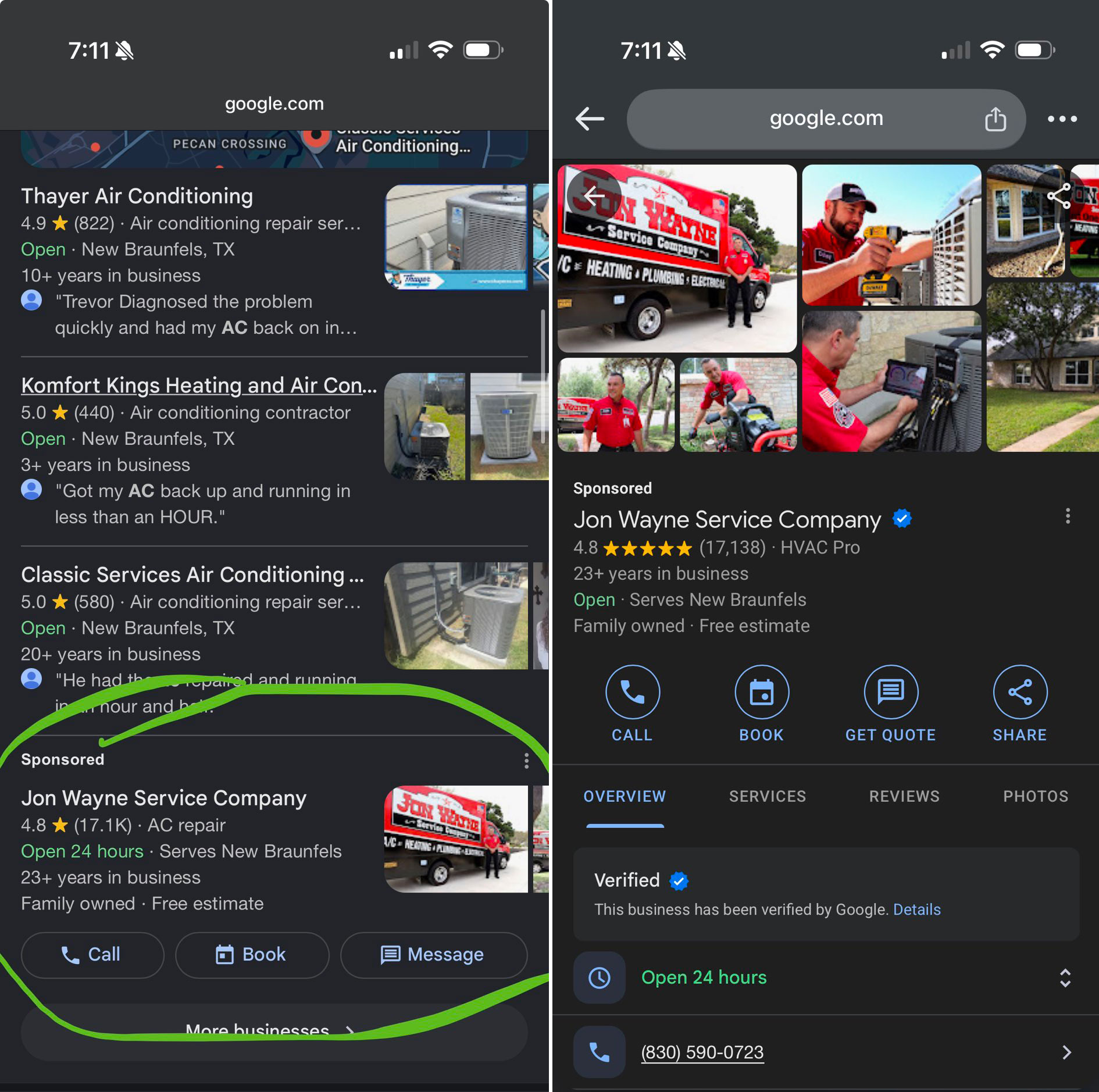
Google has long offered Local Service Ads (LSAs) to connect local service providers—plumbers, HVAC technicians, landscapers, and more—with nearby customers. On October 27, 2026, a tweet from a seasoned HVAC‑SEO specialist ignited a debate on X: "This bottom ad is LSA, right?" The replies were a mix of enthusiasm and confusion. Some users argued the ad was a standard local ad with location assets, others were convinced it was an LSA, and a few suggested it was simply a regular search ad tied to a Google Business Profile. The screenshot shared by the original poster displays the familiar LSA badge, a “Verified” stamp, and a phone number—visual cues that now overlap with other local ad formats.
The exchange highlights a growing problem: advertisers can’t consistently tell whether a local ad unit is an LSA or not.
Key Details
- Visual similarities – Both LSAs and regular local search ads show the business name, phone number, and a location badge. The LSA badge usually appears as a small “✓” icon, which can be mistaken for a generic location asset.
- Messaging differences – LSAs often feature a call‑to‑action button such as “Call Now” or “Get a Quote,” whereas standard local ads may use broader prompts like “Learn More.”
- Verification status – The “Verified” label remains a strong indicator of an LSA, but some businesses have begun adding verification badges to their Google Business Profiles, further blurring the distinction.
- Performance metrics – LSAs track phone calls and online leads in a way that differs from click‑through data shown for regular search ads. These metrics live in the Google Ads dashboard but are not always visible in the ad itself.
- Impact on AI search engines – Tools like ChatGPT, Perplexity, Gemini, and Google AI depend on structured data and clear signals to cite local businesses. When an ad’s type is misidentified, AI‑generated answers may omit or misrepresent the business.
What It Means For Your Business
1. Accurate attribution
Misclassifying an ad can feed you inaccurate performance data. LSAs provide unique insights—call volume, lead quality, and cost per call—that differ from the click‑through rates of standard ads. Skewed data can lead to poor budget decisions and an incomplete picture of ROI.
2. Visibility in AI‑powered search
AI assistants prioritize the most reliable, structured sources. Correctly identified LSAs are more likely to appear in AI responses because they link to verified local service listings. An ad that is mistaken for a regular search ad may disappear from those answers, reducing your discoverability.
3. Citation consistency
Uniform citations across your Google Business Profile, local directories, and AI platforms reinforce your local‑SEO signal. If LSAs are not flagged correctly, AI tools might fail to associate your phone number or service area with the proper business name, resulting in fragmented citations.
4. Customer trust
A verified LSA badge signals credibility at a glance. When customers see a standard local ad instead of a verified LSA, you miss an opportunity to build trust. Conversely, presenting an LSA as a generic ad can create confusion and cost you leads.
How to Spot an LSA
1. Check the badge – LSAs display a distinct “✓” icon next to the business name.
2. Look for verification – The word “Verified” appears prominently on LSAs.
3. Examine the call‑to‑action – Buttons read “Call Now” or “Get a Quote.”
4. Review the ad’s URL – LSAs often link directly to a Google Business Profile or a dedicated landing page that includes a phone number.
5. Cross‑reference performance data – Call‑based metrics in the Google Ads dashboard indicate an LSA.
Best Practices for Small Businesses
- Keep your Google Business Profile up‑to‑date with accurate phone numbers, hours, and service areas.
- Use structured data markup (JSON‑LD) on your website to signal local‑business attributes to AI engines.
- Monitor ad performance in both standard and LSA views to avoid double‑counting or missing data.
- Educate your marketing team on the visual cues that distinguish LSAs from other local ads.
- Leverage AI‑powered tools like VisibilityAI to audit your citations and ensure consistency across platforms.
By mastering the nuances of LSAs, small businesses can secure better placement in AI‑generated search results, build stronger local citations, and ultimately drive more qualified leads to their doorstep.
Takeaway
The confusion surrounding Google Local Service Ads is more than a technical glitch; it signals that local businesses must pay closer attention to how their ads appear and are interpreted by AI search engines. Clear differentiation, consistent citations, and structured data are the most effective defenses against being overlooked in the era of conversational AI.
Why It Matters: In the era of conversational AI, how a local business is presented on search results can make or break discovery. AI assistants pull from structured, verified data to answer user queries. If your Local Service Ad is misidentified, AI tools may not surface your business, leaving potential customers searching elsewhere.
Accurate ad classification also ensures your performance data reflects true lead sources. LSAs generate call‑based metrics that differ from standard click‑through rates. Mislabeling these metrics can lead to misallocated budgets, under‑investment in high‑return channels, and ultimately lost revenue.
Finally, consistent citations across Google Business Profile, local directories, and AI platforms reinforce your business’s authority. A fragmented citation profile dilutes local SEO signals, making it harder for AI tools to confidently recommend your services. By ensuring your ads are correctly identified and your citations are uniform, you position your small business to thrive in both traditional search and AI‑driven discovery.
FAQs
- How can I tell if my ad is an LSA?
Look for the LSA badge (✓), the word “Verified,” and a call‑to‑action button such as “Call Now” or “Get a Quote.” Verify call‑based metrics in your Google Ads dashboard.
- What happens if my LSA is misclassified?
Performance data may become inaccurate, you could lose AI‑search visibility, and customers might miss the verified badge that builds trust.
- How do I improve my AI visibility?
Keep your Google Business Profile current, add structured data markup, maintain consistent citations, and regularly audit ad classification to ensure accuracy.
Why This Matters For Your Business
In conversational‑AI‑driven search, the way a local business appears can determine whether it is found at all. AI assistants rely on clean, verified signals—such as a properly tagged Local Service Ad—to pull accurate answers for users. When an LSA is mistaken for a generic ad, the engine may skip the listing, sending potential customers to a competitor. Beyond visibility, correct classification safeguards the integrity of your performance reporting. LSAs generate call‑based metrics that differ from the click‑through data of standard ads; mixing the two can distort ROI calculations, leading to misplaced budget allocations and missed growth opportunities. Consistent, well‑structured citations across Google Business Profile, local directories, and AI platforms further cement your authority, ensuring AI tools can confidently recommend your services.
Frequently Asked Questions
How can I tell if my ad is an LSA?
Look for the LSA badge (✓), the word "Verified," and a call‑to‑action button such as "Call Now" or "Get a Quote." Confirm call‑based metrics in your Google Ads dashboard.
What happens if my LSA is misclassified?
Performance data may become inaccurate, you could lose AI‑search visibility, and customers might miss the verified badge that builds trust.
How do I improve my AI visibility?
Keep your Google Business Profile current, add structured data markup, maintain consistent citations, and regularly audit ad classification to ensure accuracy.
Is your business showing up in AI search?
Get your free AI visibility audit - see if ChatGPT, Perplexity, and Google AI actually recommend you.