Home / News / OpenAI Expands ChatGPT Ads Globally with Major Ad Stack Upgrade
OpenAI Expands ChatGPT Ads Globally with Major Ad Stack Upgrade
OpenAI is expanding ChatGPT Ads into international markets across Europe, India, and the Middle East while rolling out a sophisticated suite of audience management and conversion tracking tools. This update moves ChatGPT from an experimental testbed into a full-funnel performance marketing channel. For business owners and marketers tracking AI discovery, understanding how paid placements integrate with conversational answers is now critical.
Key Highlights
- ✓OpenAI expanded ChatGPT Ads to select regions across Europe, India, and the Middle East & North Africa (MENA).
- ✓Introduced dynamic custom audience tools supporting lists over 5 million users, Google Advertising IDs (GAID), and improved exclusion targeting.
- ✓Upgraded Measurement Pixel and Conversions API to match conversions using hashed customer attributes like phone numbers, names, and postal codes.
- ✓Launched product-level card reporting for carousel ads to provide granular click and impression tracking.
What Happened
OpenAI has launched a major international expansion of ChatGPT Ads, bringing sponsored placements to select countries across Europe, India, and the Middle East and North Africa (MENA). Alongside this geographic push, the company introduced an enterprise-grade advertising toolkit built to rival established ad platforms like Meta and Google.
Advertising inside conversational AI was previously an experimental endeavor reserved for select partners and baseline creative formats. With this latest release, OpenAI is building out a full performance infrastructure—adding dynamic custom audience targeting, closed-loop conversion attribution via its Conversions API and Measurement Pixel, and item-level reporting for carousel units.
The update marks a clear turning point: conversational interfaces are evolving from open-ended research assistants into measurable direct-response acquisition channels.
---
Key Details: Inside OpenAI's Upgraded Ad Stack
OpenAI's feature set zeroes in on core performance marketing mechanics, giving advertisers tighter control over targeting, audience sizing, and return on ad spend (ROAS).
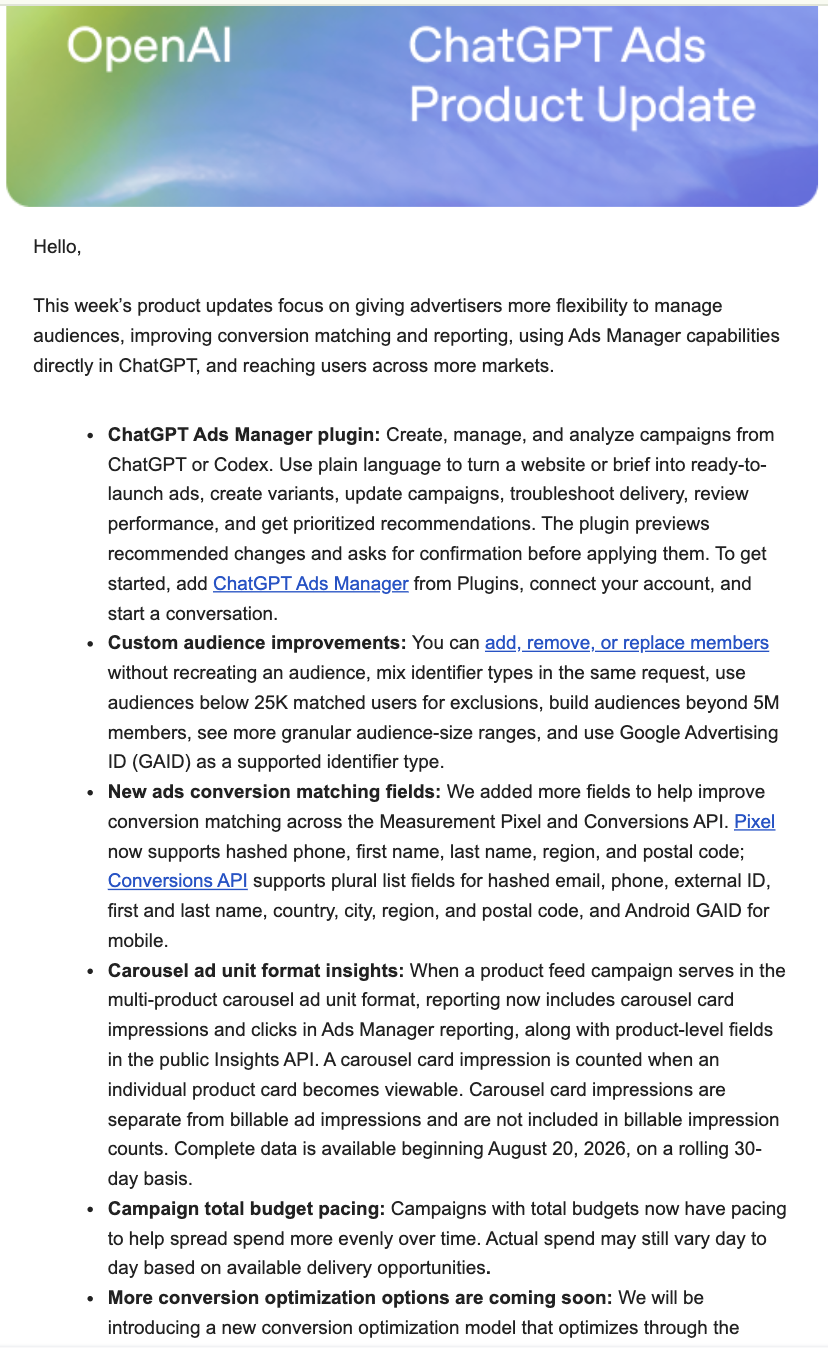
- Expanded International Reach: Sponsored placements are launching across high-volume digital ad markets in Europe, India, and MENA, allowing brands to reach millions of daily conversational sessions across several continents.
- Flexible Custom Audiences: Marketers can now update, insert, or remove audience members dynamically without rebuilding segment lists from scratch. The platform accepts mixed identifier batches in single uploads, accommodates audiences exceeding 5 million profiles, relaxes exclusion rules, and integrates the Google Advertising ID (GAID).
- Deeper Conversion Matching: To strengthen attribution, OpenAI broadened the data points accepted by its Measurement Pixel and Conversions API. Tracking tools now process securely hashed customer parameters, including names, phone numbers, postal codes, regional data, and mobile ad IDs.
- Granular Product-Level Reporting: For retail and e-commerce advertisers running product-feed carousels, OpenAI's Ads Manager and Insights API now break out impressions and clicks down to the individual card level. This lets teams evaluate top-performing inventory directly and avoid paying for non-billable visual impressions.
---
What It Means For Your Business
For business owners and growth leads, sophisticated ad tech inside ChatGPT signals an important shift in Generative Engine Optimization (GEO) and conversational discovery.
1. Paid and Organic AI Discovery Are Converging
Google evolved from ten simple organic hyperlinks into a monetized landscape filled with Local Services Ads, Shopping carousels, and sponsored packs. Conversions inside conversational AI are following the same trajectory. While earning organic citations in ChatGPT answers remains a vital objective, paid inventory will increasingly occupy prime screen space whenever users submit high-intent commercial prompts.
2. High Intent Matches Real-Time Recommendations
Consumers use ChatGPT with pointed, context-rich questions—such as "Find me the best boutique commercial roofer in Austin" or "Recommend an accounting tool for a three-person agency." Placing relevant ads directly within these interactive exchanges allows businesses to intercept active buyers right as they evaluate alternatives, delivering tailored recommendations matched to user prompts.
3. Attribution Bridges the AI ROI Gap
Proving the bottom-line value of conversational AI has historically been difficult. Thanks to OpenAI's upgraded Measurement Pixel and Conversions API, teams can now trace post-click activity, form submissions, phone inquiries, and purchases back to specific chat campaigns. That level of tracking lets marketers justify ad spend with verifiable return on investment rather than relying on loose brand-awareness assumptions.
4. How Marketers Should Prepare
- Audit Your First-Party Data: Clean and standardize your CRM records (especially emails, phone numbers, and regional identifiers) so you can take full advantage of OpenAI's expanded custom audience matching.
- Prepare Structured Product Feeds: E-commerce operators should refine their catalog data to ensure product carousel cards display accurately and feed into card-level performance reporting.
- Build a Dual AI Strategy: Keep improving your digital PR and entity signals so generative models cite you organically, while testing paid conversational ads to capture competitive commercial demand as access broadens.
Why This Matters For Your Business
The rapid commercialization of ChatGPT signals a fundamental shift in how potential customers discover, compare, and hire service providers or purchase products. In standard search, businesses competed to rank on a list of indexed web links. In generative search, users receive singular, conversational summaries. By introducing audience matching, conversion pixels, and server-side tracking, OpenAI is demonstrating that direct-response advertising will play a central role in conversational experiences. For operators focusing on Generative Engine Optimization (GEO) and AI Engine Optimization (AEO), this development proves that organic citations alone cannot carry a complete customer acquisition strategy. Just as traditional search engines integrated paid units across competitive keywords, AI engines are embedding commercial options directly into chat sessions. Early adopters who pair organic citations with targeted paid placements stand to gain a competitive edge before auction density drives up click costs. Equally important is the arrival of performance accountability. Supporting GAID targeting, first-party data uploads, and server-side conversion matching allows businesses to measure ChatGPT campaigns against the same rigorous acquisition metrics used for Google and Meta, transforming conversational AI from an experimental sandbox into a tracked growth channel.
Frequently Asked Questions
How do ChatGPT Ads differ from standard Google Search Ads?
Traditional search ads appear as text listings or shopping blocks above ranked web results. In contrast, ChatGPT Ads are woven directly into conversational responses or presented as interactive carousel cards tailored to the user's ongoing prompt history and immediate commercial intent.
Can small local businesses advertise on ChatGPT right now?
OpenAI is rolling out ad access incrementally across select markets and advertiser groups. While general availability is still expanding across Europe, India, MENA, and North America, businesses should prepare their customer data and product catalogs now so they are ready to launch campaigns as self-serve access opens up.
Will running paid ads help my business get cited organically by ChatGPT?
OpenAI maintains a structural separation between model training for organic answers and paid ad delivery. However, running paid campaigns can lift overall branded search volume, referral traffic, and digital press mentions—external authority signals that generative models frequently crawl when synthesizing organic responses.
Is your business showing up in AI search?
Get your free AI visibility audit - see if ChatGPT, Perplexity, and Google AI actually recommend you.