
Home / News / OpenAI Removes UTM Tags from ChatGPT Links – What It Means for Small Businesses
OpenAI Removes UTM Tags from ChatGPT Links – What It Means for Small Businesses
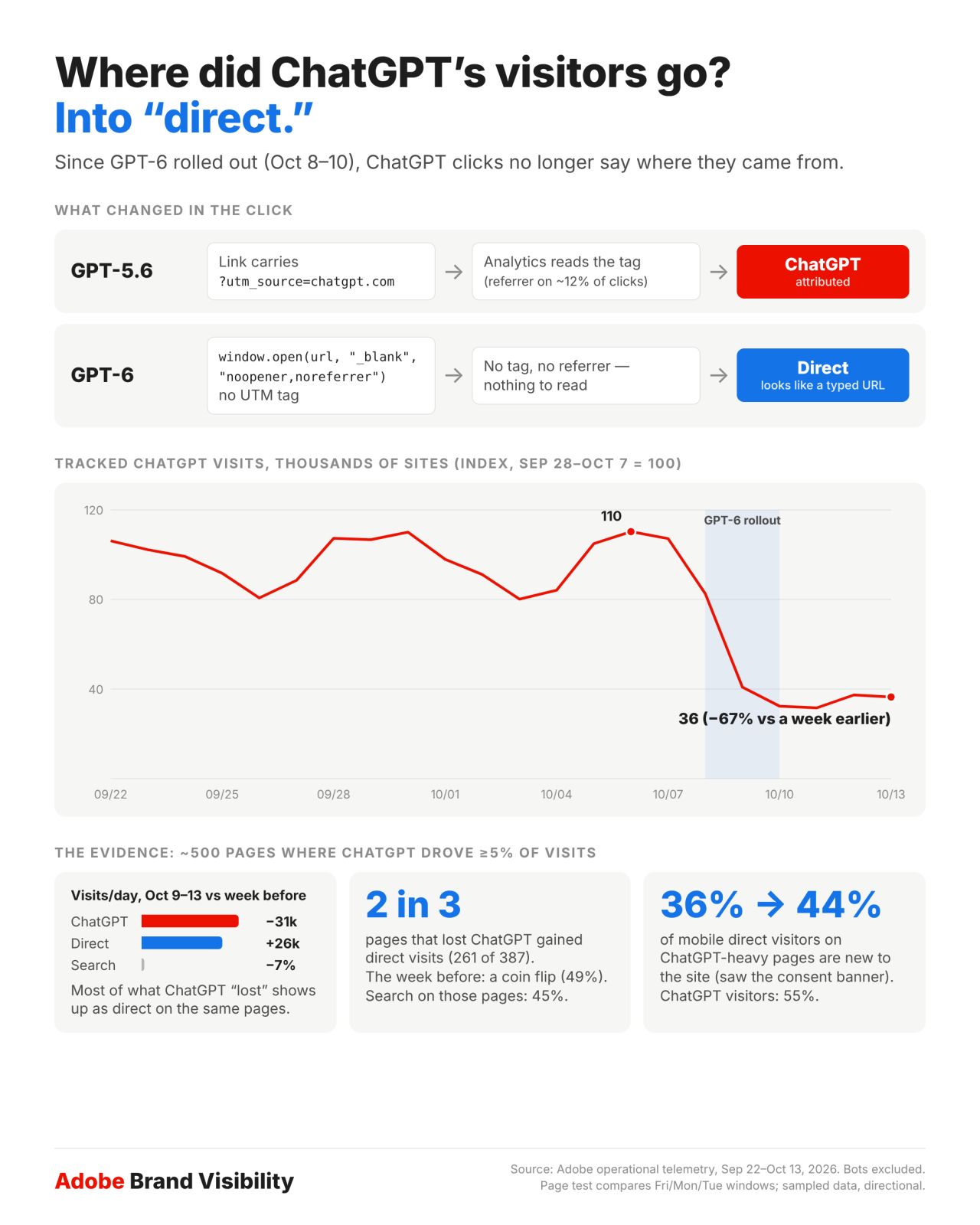
OpenAI’s GPT‑6 update eliminates the UTM tags it previously added to every outbound link in ChatGPT answers, causing AI‑driven visits to appear as direct traffic. Marketers must revise their analytics and SEO tactics to keep visibility in an AI‑first search environment.
Key Highlights
- ✓GPT‑6 removes UTM tags and referrer data from ChatGPT links
- ✓AI‑driven traffic now appears as direct visits in analytics
- ✓Businesses must adopt new attribution methods to track AI referrals
- ✓AI‑centric SEO and citation monitoring become more critical than ever
What Happened
On October 14, 2026, OpenAI released GPT‑6 and, as part of the rollout, removed the UTM parameters that had been automatically appended to every outbound link in ChatGPT responses. Earlier versions—since June 2026—added parameters such as utm_source=chatgpt.com and utm_medium=referral so site owners could see exactly how many clicks originated from the assistant. With GPT‑6, links are opened via window.open(url, "_blank", "noopener,noreferrer"), which strips the UTM query string and suppresses the referrer header. Consequently, visits are logged as direct traffic, erasing the clear signal that a user arrived via ChatGPT.
Key Details
- Technical change – GPT‑6 employs
noopener,noreferrerwhen opening links, preventing the browser from sending theRefererheader and removing any?utm_*query strings. - Timing – The modification went live the week after GPT‑6’s public launch, roughly three months after OpenAI first introduced UTM tracking in June 2026.
- Impact on data – Google Analytics, Adobe Analytics, and comparable platforms will now record the click as direct traffic, making attribution to ChatGPT impossible without extra effort.
- No official statement – OpenAI has not publicly explained the removal, but industry insiders suspect privacy concerns and a desire to treat AI‑generated referrals like organic search rather than paid referral traffic.
What It Means For Your Business
1. **Loss of a clean attribution channel**
If you depended on the utm_source=chatgpt.com tag to gauge the ROI of AI‑driven traffic, you’ll notice an abrupt drop in “ChatGPT” referrals in your reports. That dip can conceal the true value of content that surfaces in AI answers.
2. **Need for new tracking methods**
You’ll have to get inventive:
- Add custom JavaScript that flags an empty
document.referrerand a?chatgpt=trueparameter you manually embed in your own outbound URLs. - Leverage server‑side logs to spot traffic spikes that line up with popular prompts or trending topics.
- Use AI‑specific SEO tools (such as VisibilityAI) that track citation frequency across ChatGPT, Gemini, Perplexity, and Google AI Overviews.
3. **Shift in SEO strategy**
Because AI tools now treat links more like organic search results, optimizing for AI citation becomes even more crucial. Prioritize accurate local schema, rich structured data, and concise, answer‑focused copy.
4. **Potential privacy advantage**
Removing UTM tags reduces the risk of being flagged for “tracking” users without consent, bringing you closer to emerging privacy regulations in the EU and several U.S. states.
Actionable Steps for Small Business Owners & Marketers
- Audit your current analytics – Look for a sudden dip in “ChatGPT” traffic and note when it began.
- Implement fallback UTM tags on your own outbound links (e.g.,
?src=chatgpt), then use a URL shortener that preserves the tag when the AI strips it. - Update your attribution model – Create a “Direct (AI)” segment in Google Analytics to capture traffic with no referrer but strong engagement metrics.
- Focus on AI‑friendly content – Craft clear, concise answers to common local queries, embed FAQs, and use bullet points that AI can easily extract.
- Monitor AI citation platforms – Services like VisibilityAI can alert you when your business appears in a ChatGPT answer, even if the click registers as direct.
Key Takeaways
- OpenAI’s GPT‑6 drops UTM parameters and referrer data from ChatGPT links.
- This change obscures direct attribution of AI‑driven traffic.
- Businesses must adapt analytics, reinforce AI‑centric SEO, and use alternative tracking to continue measuring performance.
- VisibilityAI and similar services become essential for monitoring AI citations when traditional metrics fall short.
---
Frequently Asked Questions
Q1: Will the removal of UTM tags affect paid advertising campaigns?
A1: No. The change only impacts organic AI referrals. Paid ads on platforms like Google, Facebook, or Bing continue to use their own UTM parameters and tracking pixels.
Q2: Can I still see which specific ChatGPT prompt led to a click?
A2: Not through standard analytics alone. Combining AI‑citation monitoring tools with server‑side logs can help you infer the originating prompt.
Q3: Should I stop optimizing for AI search because of this change?
A3: Absolutely not. AI assistants are becoming the primary discovery layer for many consumers. The loss of UTM tags simply means you need smarter attribution, not less optimization.
Why It Matters: For local businesses, the majority of new customers are found through quick answers on AI assistants rather than traditional search results. When OpenAI strips UTM parameters, marketers lose a clear line of sight into how many visitors are arriving from ChatGPT, Gemini, Perplexity, or Google AI Overviews. Without that data, justifying content investments, allocating budget, or proving ROI to stakeholders becomes far more challenging.
VisibilityAI’s mission is to surface those hidden citation pathways. By tracking when a business is mentioned in an AI response—even if the click is recorded as "direct"—you can still gauge the impact of your AI SEO efforts. This ensures you remain discoverable, cited, and ultimately chosen by consumers who rely on AI for local recommendations.
Why This Matters For Your Business
Local businesses increasingly depend on AI assistants to surface quick answers, often bypassing traditional search results. When OpenAI removes UTM tags, the traffic that originates from ChatGPT and similar tools disappears into the "direct" bucket, making it hard to demonstrate the value of AI‑driven exposure. Without clear attribution, marketers may struggle to justify the time and resources spent on AI‑focused content. VisibilityAI addresses this blind spot by monitoring when a brand is cited in AI responses, even when the click is logged as direct traffic. By surfacing those hidden citation events, the platform helps businesses prove ROI, fine‑tune their AI SEO strategy, and continue to attract customers who rely on AI for local recommendations.
Frequently Asked Questions
How can I still track ChatGPT clicks without UTM parameters?
Combine custom URL parameters you control, server‑side log analysis, and AI‑citation monitoring tools that flag when your brand appears in a ChatGPT answer.
Will this change affect other AI platforms like Gemini or Perplexity?
Each platform handles link attribution differently. Gemini still adds its own tracking, while Perplexity follows a similar approach to ChatGPT. Monitor each service individually.
Is the loss of referrer data a privacy violation?
No. Removing the referrer actually aligns with emerging privacy regulations by limiting the amount of user‑level data shared across domains.
Is your business showing up in AI search?
Get your free AI visibility audit - see if ChatGPT, Perplexity, and Google AI actually recommend you.